
Sober Curious in 2026: The Definitive Guide
Drink less, live more. Explore the data, psychology and practical playbook behind the sober curious movement—without labels or judgment.
You’ve seen the hashtag. You’ve heard it discussed on podcasts. You’ve noticed the explosion of sophisticated non-alcoholic options in grocery aisles and on bar menus. Maybe you even have a friend who recently announced they are "sober curious."
But what does it actually mean? And why is this movement reshaping how a generation thinks about alcohol?
If you’ve found yourself questioning the role alcohol plays in your life—whether it’s the sluggish mornings after a casual happy hour, the realization that you use wine to manage stress or simply a nagging feeling that drinking isn't serving you anymore—you've come to the right place.
Welcome to the movement.
Being sober curious isn't about rigid labels, all-or-nothing sobriety or deprivation. It is about intentionality. It is the conscious decision to examine the cultural programming, habits and assumptions that surround alcohol, then choose a lifestyle that prioritizes health, clarity and authentic connection.
This guide is the definitive exploration of the Sober Curious movement in 2026. We will unpack the data behind this massive cultural shift, define what the movement truly represents and provide a practical playbook for exploring a life with less alcohol—and discovering what you might gain in the process.
Part I: Understanding the Movement
The conversation around alcohol has historically been binary: either you are a "normal drinker" who can handle alcohol without issue, or you are an "alcoholic" who must abstain completely.
The Sober Curious movement rejects this binary. It opens up a vast, judgment-free middle ground—often referred to as the "gray area"—for the millions of people who don't identify as having a severe alcohol use disorder, but who also recognize that their drinking habits are negatively impacting their well-being.
The Origin Story: Beyond All-or-Nothing
The term "Sober Curious" was popularized by author Ruby Warrington in her influential 2018 book, Sober Curious: The Blissful Sleep; Greater Focus; Limitless Presence; and Deep Connection Awaiting Us All on the Other Side of Alcohol.
Warrington recognized a gap in the cultural conversation. Traditional recovery programs, while vital for those with alcohol dependency, often felt alienating or inaccessible to those who simply wanted to drink less for wellness reasons.
She proposed a new approach: one that invites curiosity rather than mandates rules.
The framing is simple: choose to question every impulse, invitation and expectation to drink instead of going along with the dominant drinking culture.
This framing shifted the focus from what you are (an alcoholic or not) to why you drink. It empowers individuals to examine their relationship with alcohol without the stigma often associated with traditional sobriety.
Defining the Terms: The Spectrum of Intentional Drinking
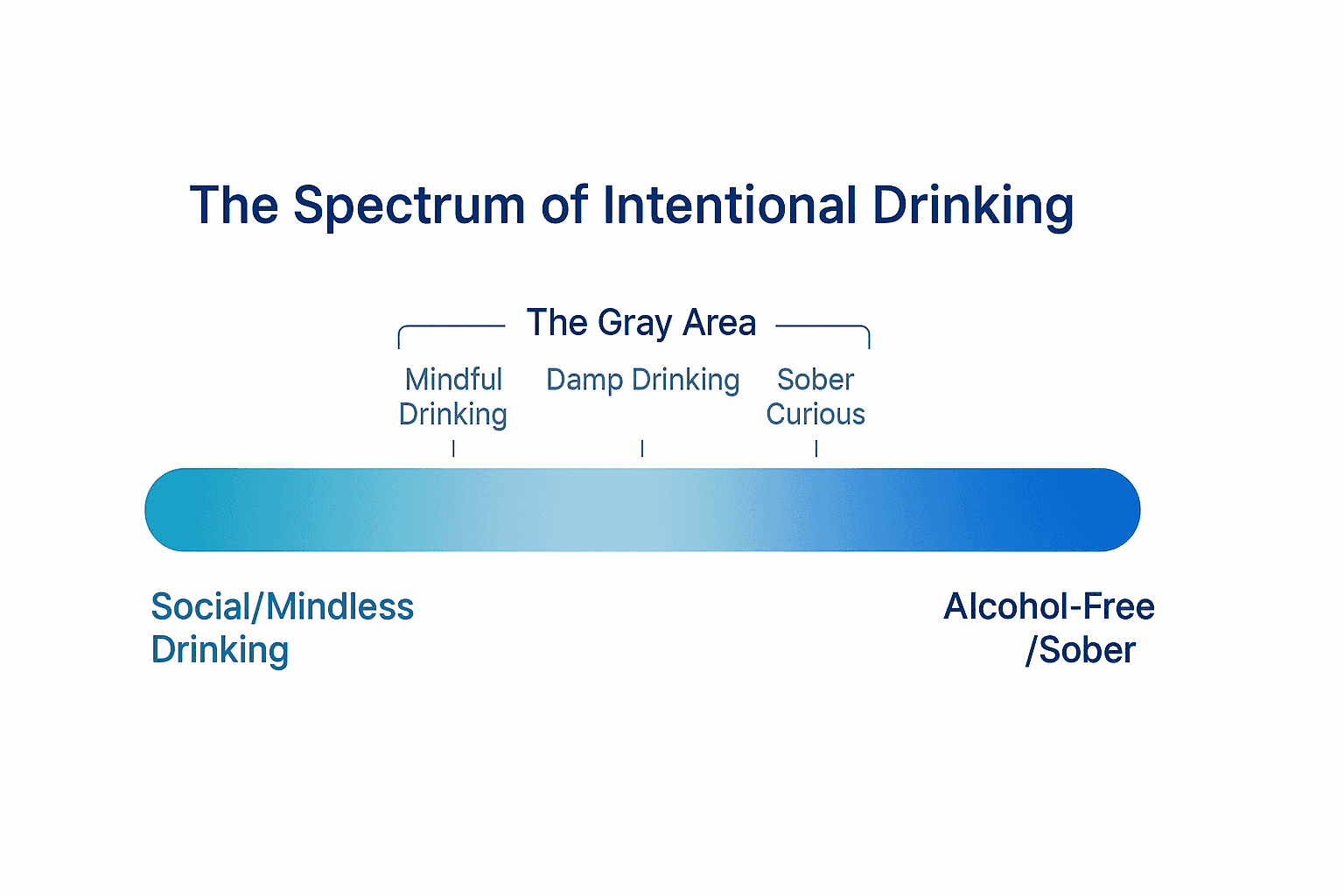
As the movement has grown, the language surrounding it has evolved. It’s helpful to understand where different terms fall on the spectrum of intentional drinking:
1. Mindful Drinking
Definition: The practice of being consciously aware of why, when and how much alcohol you are consuming.
The Vibe: A mindful drinker might still enjoy alcohol, but they do so with intention. They might set limits before going out, savor the taste rather than drinking to get drunk and consciously choose not to drink on certain days. It is about control and awareness.
2. Sober Curious
Definition: Actively questioning the role of alcohol in one's life and often experimenting with periods of abstinence.
The Vibe: This is a more active exploration than mindful drinking. A sober curious individual is often taking intentional breaks from alcohol (like a 30-day reset) to gather data on how they feel without it. They are critically examining the cultural pressure to drink and exploring alternatives.
3. Moderation / The Moderator (including "Damp Drinking")
Definition: Individuals who consciously regulate their alcohol intake to stay within low-risk guidelines.
The Vibe: Similar to mindful drinking, but often with flexible rules or guidelines (e.g., "I only drink on weekends" or "I never have more than two drinks"). The term "Damp Drinking," popularized on social media, falls into this category—a conscious reduction without full abstinence.
4. Gray Area Drinking (GAD)
Definition: The spectrum between "normal" social drinking and severe alcohol use disorder.
The Vibe: This describes the often-uncomfortable space where drinking is causing negative consequences (hangovers, anxiety, health concerns) but the individual does not meet the clinical criteria for dependency. The Sober Curious movement is largely composed of people navigating this gray area.
5. Alcohol-Free / Sober
Definition: Complete abstinence from alcohol.
The Vibe: This describes individuals who have decided that alcohol has no place in their lives, whether for health reasons, personal choice or because they are in recovery from an alcohol use disorder.
The beauty of the Sober Curious movement is that it welcomes everyone on this spectrum (with the important caveat that it is not a substitute for professional treatment for alcohol dependency). It is a fluid identity; you might start as sober curious, move into mindful drinking or ultimately decide that an alcohol-free life is the best fit for you.
The Psychology of Questioning the Default
To understand the power of the Sober Curious movement, we must first understand the pervasive nature of alcohol in our society. Alcohol is the only drug we have to justify not taking.
Drinking is the cultural default. We drink to celebrate, mourn, network, relax, socialize and even participate in "wellness" activities (e.g., wine yoga). This normalization is so complete that choosing not to drink is often met with suspicion or pressure.
The Sober Curious movement challenges this default. It asks the radical question: "What if alcohol is not the key ingredient to fun, relaxation or connection?"
This shift in mindset involves recognizing and dismantling several deeply ingrained cultural myths:
Myth: I need alcohol to relax or de-stress.
Curiosity: What are healthier ways to manage stress? How does alcohol actually affect my anxiety levels the next day?
Myth: I need alcohol to be social or fun.
Curiosity: Am I truly connecting with people when I drink? What would a social event feel like if I were fully present?
Myth: A sophisticated life involves fine wine and craft cocktails.
Curiosity: What defines sophistication? Can I enjoy a premium experience without the ethanol?
By adopting a stance of curiosity, individuals move from passive participants in the drinking culture to active architects of their own lifestyles.
Part II: The State of the Surge: Why Now?
The Sober Curious movement is not a fleeting trend; it is a profound cultural shift driven by verifiable data and fundamental changes in consumer values. By 2026, the movement has reached a tipping point.
The Data Doesn't Lie: A Generational Shift
The statistics paint a clear picture of a society actively re-evaluating its relationship with alcohol.
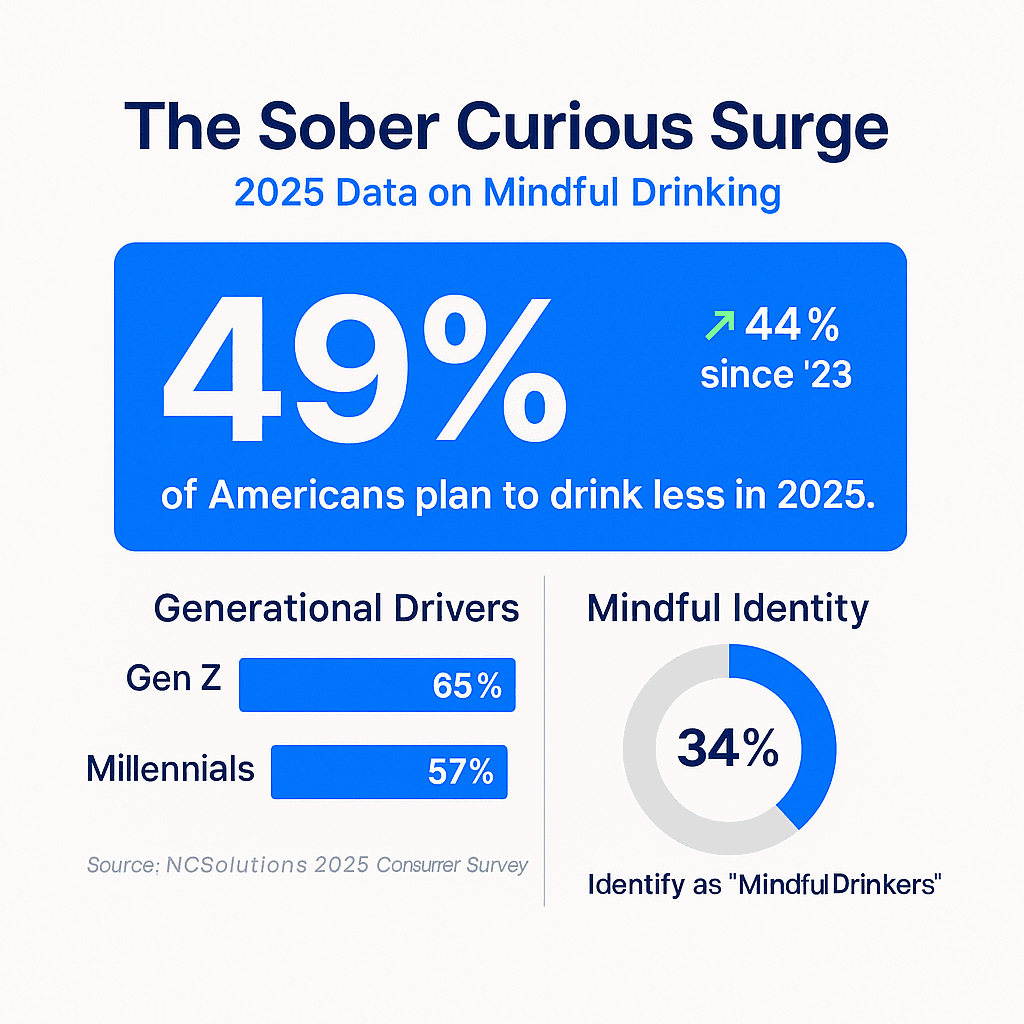
According to a comprehensive 2025 consumer sentiment survey by NCSolutions, a leading market research firm:
Nearly half (49%) of all Americans plan to drink less alcohol in 2025.
This represents a staggering 44% increase in the number of people seeking to reduce their intake since 2023.
The number of Americans identifying as "mindful drinkers" jumped from 26% in 2023 to 34% in 2025.
This shift is most pronounced among younger generations, who are increasingly prioritizing health and wellness over traditional drinking habits.
65% of Gen Z plan to reduce their alcohol consumption in 2025.
57% of Millennials plan to reduce their alcohol consumption in 2025.
These demographics are the driving force behind the Sober Curious movement and the rapid growth of the non-alcoholic beverage market.
The Driving Forces: Top 5 Reasons People Are Going Sober Curious
Why are millions of people suddenly eager to drink less? The motivations are multifaceted, extending far beyond the simple avoidance of hangovers.
1. The Physical Health Imperative
The increased awareness of the long-term health impacts of alcohol is the single biggest driver of the Sober Curious movement. The NCSolutions survey found that the #1 reason Americans are drinking less is to improve physical health.
In recent years, the scientific consensus on alcohol has become impossible to ignore. The World Health Organization (WHO) has stated clearly: there is no safe level of alcohol consumption that does not affect health.
Key health realizations driving the shift:
Alcohol is a Carcinogen: The classification of alcohol as a Group 1 carcinogen (the same category as tobacco) has been a wake-up call for many health-conscious consumers. Even moderate drinking increases the risk of several types of cancer.
Sleep is Sacred: While alcohol can induce drowsiness, it is devastating to sleep quality. It disrupts the REM cycle, preventing the body from achieving deep, restorative sleep. For a generation obsessed with optimizing wellness and performance, this is a non-negotiable trade-off.
Fitness and Performance: Alcohol consumption negatively impacts muscle recovery, hydration and athletic performance. As fitness culture continues to thrive, many are finding that alcohol is incompatible with their goals.
2. The Mental Wellness Revolution
The second most cited reason for drinking less is to improve mental health. The link between alcohol and mental well-being is complex, and the conversation around it has become more open and destigmatized.
The "Hangxiety" Phenomenon: The feeling of anxiety, dread and unease that often follows a night of drinking—colloquially known as "hangxiety"—is a major deterrent. Alcohol disrupts the delicate balance of neurotransmitters in the brain, including GABA, serotonin and dopamine, leading to increased anxiety and low mood in the days following consumption.
The Productivity Paradox: In a competitive economic environment, professionals are seeking ways to optimize their cognitive function. The brain fog, fatigue and decreased focus associated with even moderate drinking are increasingly seen as unacceptable costs.
Emotional Regulation: Many people use alcohol to numb difficult emotions or manage stress. The Sober Curious movement encourages individuals to develop healthier coping mechanisms and to address the root causes of their discomfort rather than masking them with alcohol.
3. The Financial Dividend
The third major driver is simple economics: saving money.
The rising cost of living, combined with the premium pricing of craft cocktails and fine wines, has made drinking an expensive habit.
When individuals reduce their alcohol consumption, they often experience a "sobriety dividend"—a noticeable increase in disposable income. This money can then be redirected toward other priorities, such as travel, hobbies, paying down debt or investing in wellness experiences.
4. The Desire for Authentic Connection
For decades, alcohol has been positioned as the ultimate social lubricant—a necessary ingredient for bonding, networking and dating. However, the Sober Curious movement challenges this assumption.
Many are discovering that alcohol can actually be a barrier to authentic connection. It can lead to superficial conversations, blurred memories and interactions colored by intoxication rather than genuine presence.
By removing alcohol from the equation, individuals often find they are able to be more present, vulnerable and engaged in their relationships. The rise of sober bars, alcohol-free meetups and mindful dating trends speaks to this growing desire for connection that doesn't rely on a buzz.
5. The Explosion of High-Quality Alternatives
Finally, and perhaps most critically, the Sober Curious movement is fueled by innovation. The rapid growth and improvement of the non-alcoholic beverage industry have completely changed the landscape of choice.
This factor is so significant that it deserves its own section.
Part III: The NA Revolution: A New Era of Choice
It is impossible to discuss the Sober Curious movement without acknowledging the revolution in non-alcoholic beverages. The correlation is clear: as the desire to drink less has grown, the market has responded with an explosion of sophisticated, flavorful and satisfying alternatives.
From Penalty Box to Premium Pour
Historically, the options for non-drinkers were dismal: sugary sodas, bland NA lagers or a club soda with lime. Not drinking felt like a punishment or an afterthought. This lack of appealing options made the social experience of abstaining difficult and isolating.
By 2026, the landscape is unrecognizable. The non-alcoholic beverage market is one of the fastest-growing segments in the entire food and beverage industry, projected to grow at a Compound Annual Growth Rate (CAGR) of 6.0% to 8.56% globally (Grand View Research).
The modern NA beverage aisle is a vibrant space featuring:
Craft NA Beers: From hazy IPAs and rich stouts to crisp lagers that are virtually indistinguishable from their alcoholic counterparts. (Internal Link: See our analysis of Is Non-Alcoholic Beer Really Healthier?)
Sophisticated NA Wines: Dealcoholized sparkling rosés, Chardonnays and Cabernet Sauvignons that offer the complexity and ritual of wine without the alcohol.
Artisanal NA Spirits: Non-alcoholic gins, whiskeys, tequilas and aperitifs crafted with botanicals, distillates and extracts designed to mimic the flavor profile and mouthfeel of traditional spirits.
Functional Beverages: Drinks infused with adaptogens, nootropics and botanicals designed to provide a specific effect, such as relaxation or focus, offering a "buzz" without the booze.
Why Modern NA Drinks Make Being Sober Curious Easy
The rise of these high-quality alternatives has been a game-changer for the Sober Curious movement for several key reasons:
The Power of Ritual
The act of drinking is often more about the ritual than the alcohol itself—the pop of a cork, the clink of glasses, the act of pouring a "special" drink at the end of a long day. Modern NA beverages allow individuals to maintain these deeply ingrained rituals without the negative consequences of alcohol. Having a satisfying, adult beverage in hand eases the transition and eliminates the feeling of deprivation.
The Social Comfort Factor
In social situations, having a drink in hand is a powerful social norm. Holding an NA beer or a sophisticated mocktail allows individuals to blend in, avoid awkward questions and feel like they are part of the celebration without having to consume alcohol. It removes the social friction that often accompanies abstinence.
The Flavor Experience
Modern NA beverages taste good. They are crafted with the same care and attention to detail as their alcoholic counterparts, offering the complexity, bitterness, acidity and mouthfeel that adult palates crave. This means that choosing an NA option is no longer a compromise; it is a positive choice for flavor and experience.
By providing viable, appealing alternatives, the NA beverage industry has effectively lowered the barrier to entry for the Sober Curious lifestyle.
Plant-Based Alternatives: A Quick Note
Beyond NA beer and mocktails, you'll see kanna, kava, and other botanicals marketed as alcohol alternatives. Kanna in particular has serotonergic activity that matters if you take SSRIs or other mood-affecting medications.
Curious how much you really drink?
Use our standard drink calculator and get insights you can act on today.