
Dealcoholized vs. Non-Alcoholic vs. Alcohol-Free: What the Labels Actually Mean
Dealcoholized, non-alcoholic, and alcohol-free are not interchangeable. We explain the ABV thresholds and how US, UK, and EU labels differ — plus how the alcohol is removed.
TL;DR
- “Non-alcoholic” usually isn’t zero. In the US it typically means under 0.5% ABV.
- “Dealcoholized” describes how it was made: alcohol was removed. It doesn’t tell you how much is left.
- “Alcohol-free” is the strictest phrase, but the bar changes by country: no alcohol for US beer, up to 0.05% under England’s guidance.
- Read the ABV number, not just the word.
The three words in plain English
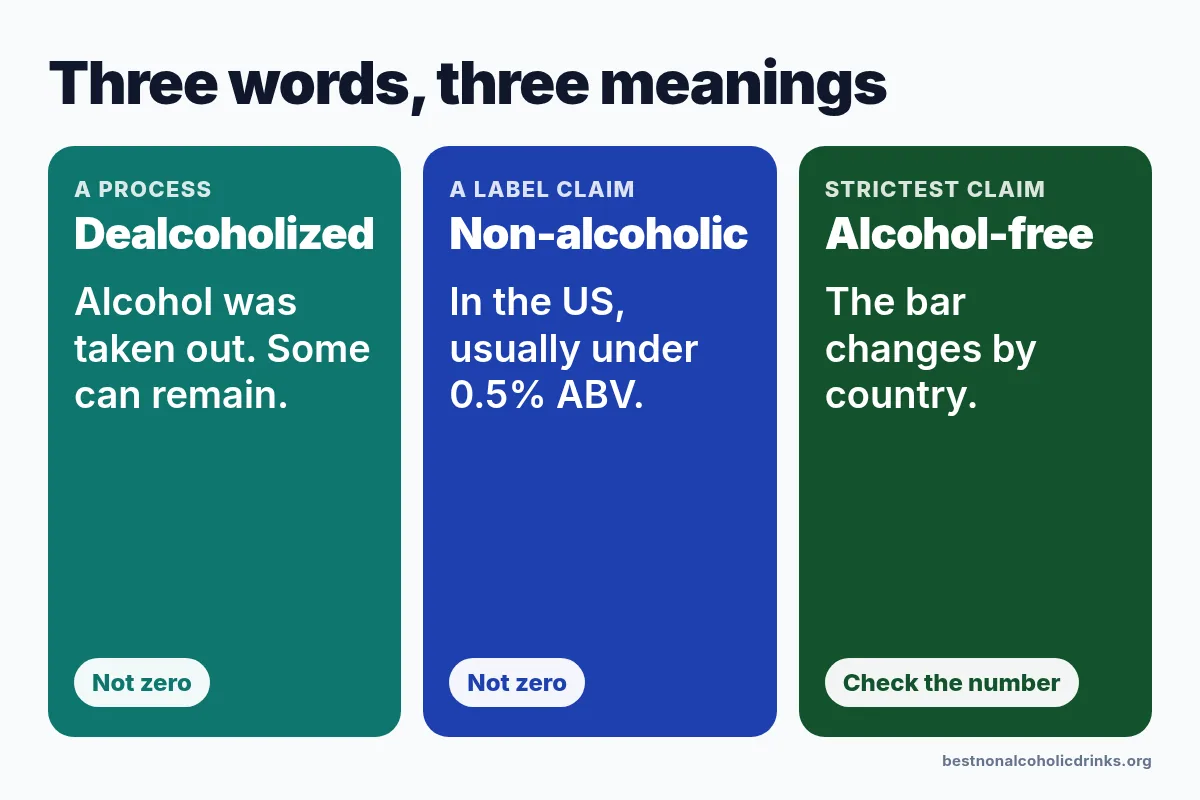
| Word | What it tells you | Zero alcohol? |
|---|---|---|
| Dealcoholized (also de-alcoholised or alcohol-removed) | It started with alcohol, then most of it was taken out. A method, not an amount. | Not necessarily |
| Non-alcoholic | A label claim. Its meaning depends on the country and the drink. | Not necessarily |
| Alcohol-free | The strictest everyday label claim. | Depends on the country |
Most non-alcoholic wine is made by taking the alcohol out of wine, with vacuum distillation, reverse osmosis, a spinning cone or something similar. That’s the typical path, not a legal rule.
Want bottles instead of definitions? See the best alcohol-free wines and the best non-alcoholic beers.
The numbers that matter
ABV (alcohol by volume) is the share of a drink that’s alcohol. For scale, the NIAAA uses about 5% for a regular beer and about 12% for a glass of wine. Those are everyday examples, not legal limits.
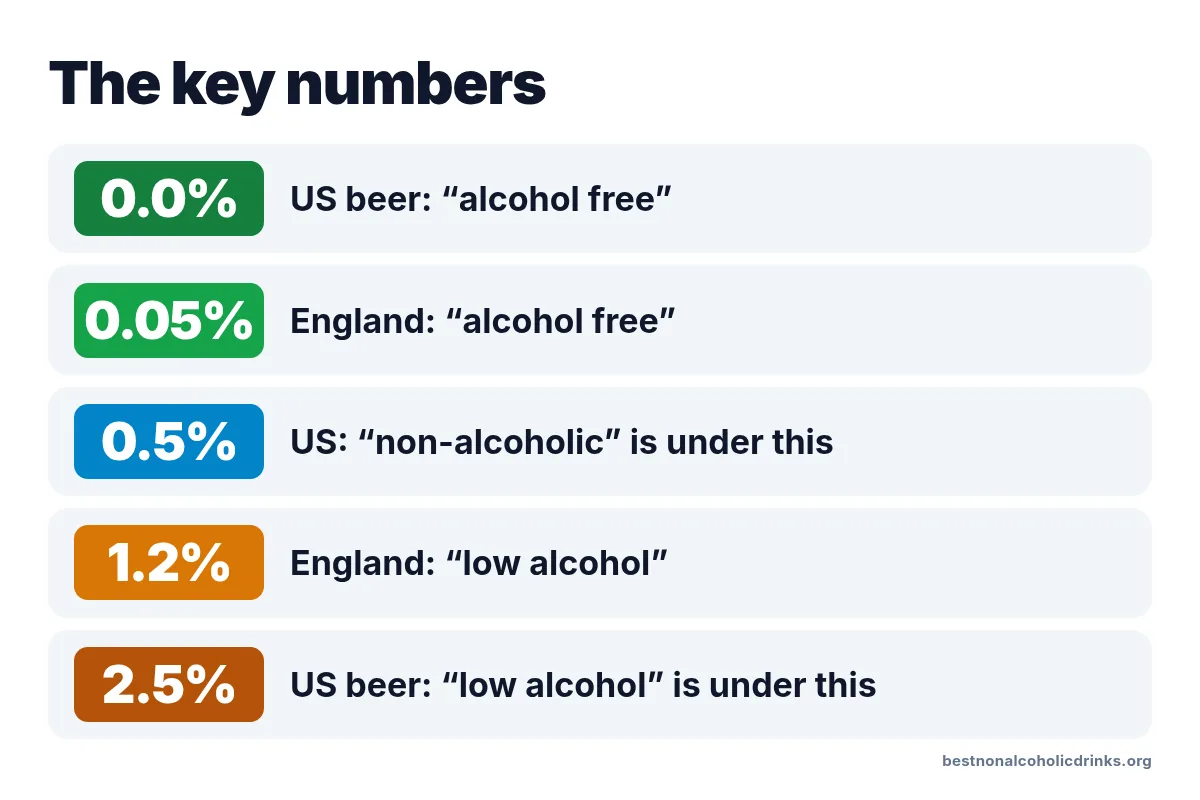
The legal lines you’ll see again and again are 0.5%, 0.05% and, in some US rules, no alcohol at all.
US vs. England vs. EU at a glance
| Label | United States | England (2018 guidance) | EU wine |
|---|---|---|---|
| Non-alcoholic | Beer: under 0.5% ABV, with that statement next to it. Wine: allowed only as an extra word, not the main one. | Generally shouldn’t be used with a name tied to an alcoholic drink (narrow sacramental-wine exception). | Not the main legal term. |
| Alcohol-free | Beer: no alcohol. Wine: no detectable alcohol. | Alcohol extracted, 0.05% ABV or less, strength on the label. | Not a legal wine term yet. From 19 September 2027: 0.5% or less, plus “0,0 %” if 0.05% or less. |
| Dealcoholized / de-alcoholised | Wine: “dealcoholized” or “alcohol-removed” before “wine,” plus “contains less than 0.5% alcohol by volume.” | Alcohol extracted, 0.5% ABV or less, strength on the label. | Today: “de-alcoholised” if 0.5% or less, “partially de-alcoholised” above that. |
| Low / reduced alcohol | Beer: under 2.5% ABV. | 1.2% ABV or less, with the maximum ABV on the label. | From 2027: “reduced alcohol” means above 0.5% and at least 30% below the category minimum. |
Two things to keep in mind:
- The England column is guidance for England. It isn’t automatically UK-wide law.
- The EU 2027 terms are written but not in force. A bottle on a shelf in 2026 follows today’s rules.
United States
Beer
The rule is TTB’s 27 CFR § 7.65.
- Non-alcoholic: the beer must contain less than 0.5% ABV, and “contains less than 0.5 percent (or .5%) alcohol by volume” must appear right next to the term. No tolerance.
- Alcohol free: only if it contains no alcohol.
- 0.0%: only if it’s also labeled alcohol free and contains no alcohol.
- Low or reduced alcohol: under 2.5% ABV.
Wine
Federal law generally treats wine as 7–24% ABV. So a dealcoholized wine under 7% usually falls under FDA food labeling, not TTB alcohol labeling. That’s the usual split, though TTB isn’t entirely out of the picture.
FDA’s Compliance Policy Guide Sec. 510.400 says:
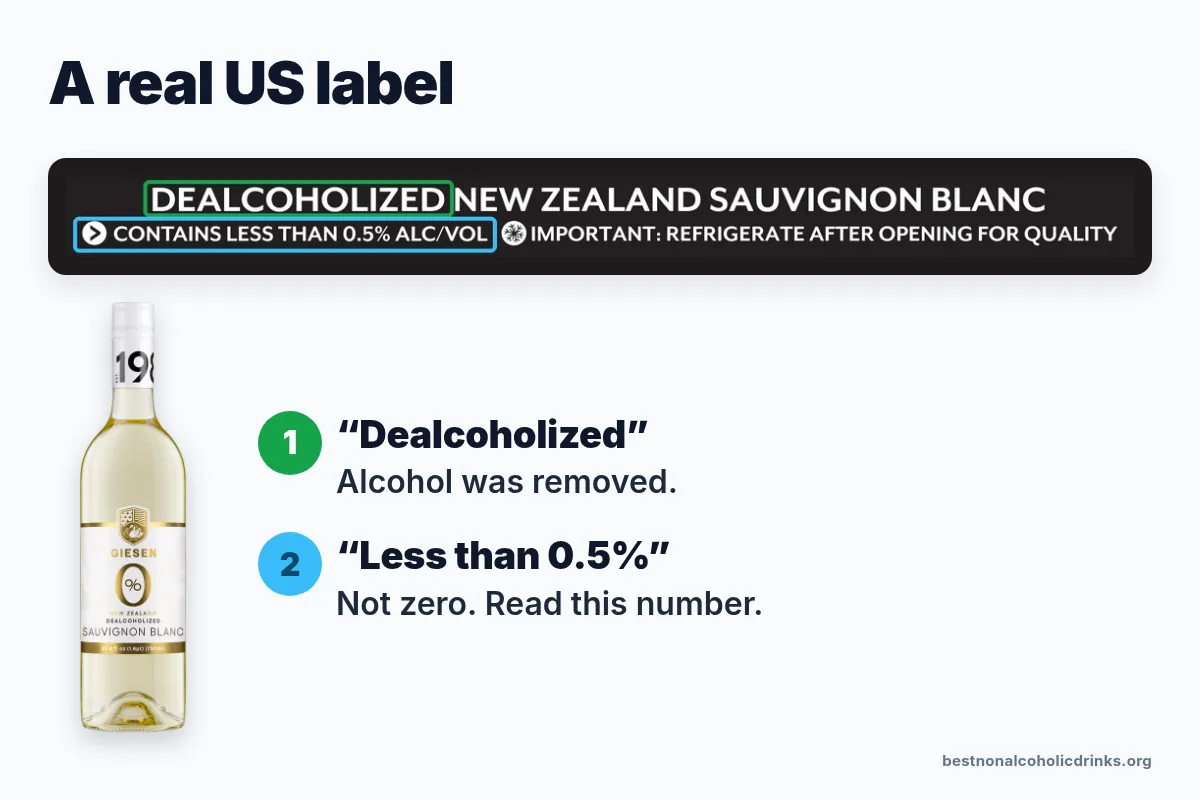
- Call it “dealcoholized” or “alcohol-removed” wine, followed by “contains less than 0.5 percent alcohol by volume.”
- Those words are misleading if the wine is over 0.5% ABV.
- “Non-alcoholic” can be added, but it shouldn’t be the only word before “wine.”
- “Alcohol-free” only when there’s no detectable alcohol.
The big picture
In a February 2026 presentation, TTB said finished drinks under 0.5% ABV “are not considered alcohol beverages under federal regulations.”
They aren’t taxable under the Internal Revenue Code and are generally not subject to TTB rules, with exceptions. Dealcoholized wine under 0.5%, for example, can still face some formula and labeling requirements.
It’s an overview, not a substitute for the regulation or the FDA guide.
England and the UK
The document people cite is the Department of Health and Social Care’s Low Alcohol Descriptors Guidance from 13 December 2018. It’s voluntary guidance for England, not automatic UK-wide law.
- Low alcohol: 1.2% ABV or less, with the maximum ABV on the label.
- Alcohol free: alcohol extracted, 0.05% ABV or less.
- De-alcoholised: alcohol extracted, 0.5% ABV or less.
- Non-alcoholic: shouldn’t be used with a name tied to an alcoholic drink, except communion or sacramental wine made from unfermented grape juice.
Two more limits:
- “Wine” is generally reserved for 8% ABV and up (with some PDO exceptions). That’s why lower-alcohol versions are often called a “wine-based drink.”
- No “alcohol free gin.” GOV.UK says: “You cannot label an ‘alcohol free’ or ‘low alcohol’ beverage against a spirit drink name, for example ‘alcohol free rum’ or ‘low alcohol gin.’” So UK bottles say “spirit drink,” “alternative” or just the brand name.
Could 0.05% change?
The UK government consulted in 2023 on raising the “alcohol free” limit to 0.5%. GOV.UK still says it’s analysing the feedback.
In a written answer on 21 October 2025 (UIN 82267), a minister said one first step will be to “explore raising the upper alcohol limit for drinks labelled as alcohol-free to 0.5% alcohol by volume (ABV) from 0.05% ABV.” For now, 0.05% is the published figure.
European Union
EU wine rules are harmonized. Beer rules aren’t.
Wine today
Under Regulation (EU) No 1308/2013, as amended by Regulation (EU) 2021/2117:
- De-alcoholised: 0.5% ABV or less.
- Partially de-alcoholised: above 0.5% and below the category’s minimum strength before de-alcoholisation.
The European Commission published a Q&A on this (Commission Notice C/2024/694).
Wine from 19 September 2027
Regulation (EU) 2026/471 changes the required label terms:
- Alcohol-free: 0.5% ABV or less, plus “0,0 %” if it’s 0.05% or less. “0,0 %” can’t stand alone.
- Reduced alcohol: above 0.5% and at least 30% below the category minimum before de-alcoholisation.
- A new required line: “produced by de-alcoholisation.”
These aren’t in force yet.
Beer
We couldn’t confirm one EU-wide legal definition of “alcohol-free beer.” National limits vary, so read the number on the can.
Beer, wine and spirits play by different rules
The drink type matters as much as the country.
- Beer: In the US, “non-alcoholic” means under 0.5%, while “alcohol free” and “0.0%” mean none. England’s 0.05% “alcohol free” line is much tighter, so a US non-alcoholic beer doesn’t automatically count as alcohol free there.
- Wine: Usually dealcoholized. You’ll see “dealcoholized” or “alcohol-removed” in the US, “de-alcoholised” in the EU, and sometimes “wine-based drink” in England. Our ranking is called Best Alcohol-Free Wines because that’s the everyday name, but many bottles sit under 0.5%, not at zero. Check each label.
- Spirits: The messiest. UK guidance doesn’t want “alcohol free” paired with a spirit name like gin. In the US, a finished drink under 0.5% generally isn’t a TTB “alcohol beverage,” so many are sold as non-alcoholic spirits or alternatives under FDA food rules. There’s no single global name for a zero-proof gin.
How the alcohol comes out
Almost all non-alcoholic wine, and some beer, starts full-strength. Then the alcohol is removed.
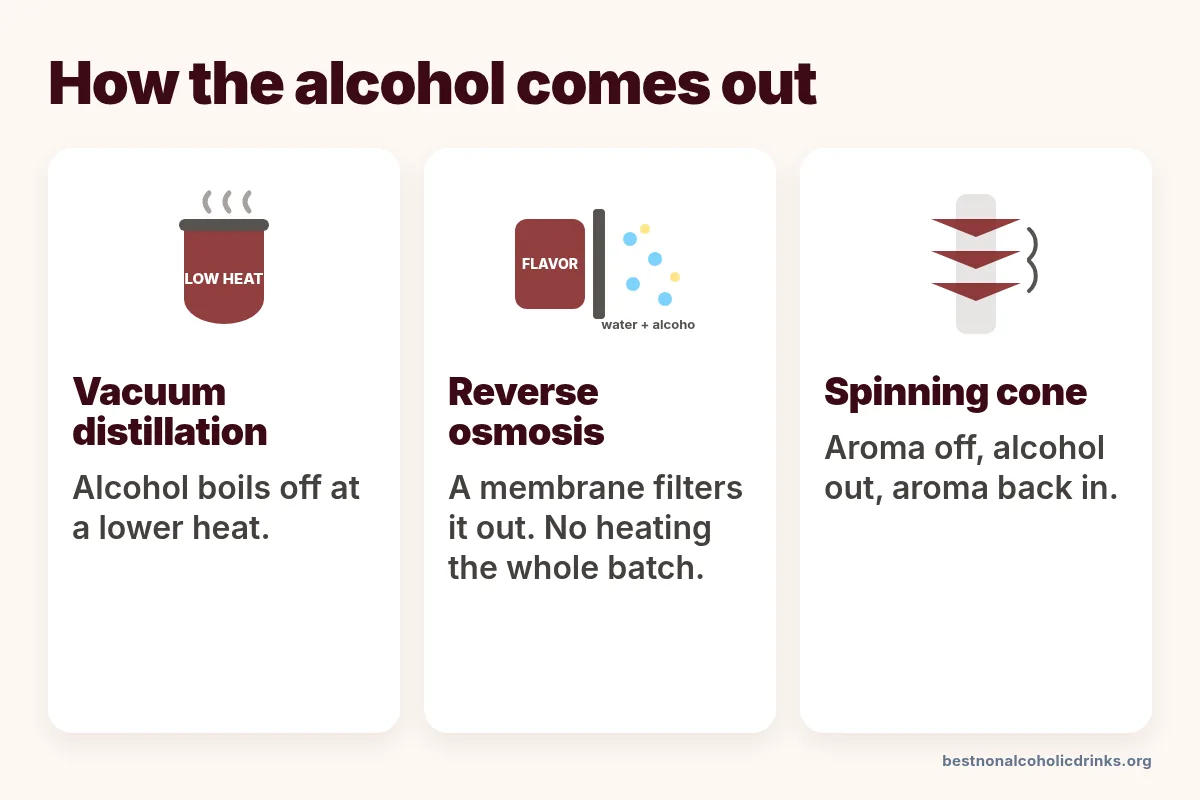
- Vacuum distillation: Lower pressure lets alcohol boil off with less heat. Some aroma can leave too, so many producers capture it and add it back.
- Reverse osmosis: A membrane splits off water, alcohol and some small molecules. The alcohol is removed, then the water and flavor are blended back. You avoid heating the whole batch, but some light aromas can still be lost.
- Spinning cone: A vacuum-distillation setup with spinning cones. Producers often take the aroma off first, then the alcohol, then add the aroma back. Giesen, whose 0% Sauvignon Blanc is #1 (4.4/5) on our alcohol-free wine ranking, says on its site that it uses this process. That’s the producer’s description, not a ranking of methods.
What EU wine rules allow
- Three methods, alone or combined: (a) partial vacuum evaporation, (b) membrane techniques and (c) distillation. That’s Annex VIII, Part I, Section E of Regulation 1308/2013, as amended by 2021/2117.
- The process “shall not result in organoleptic defects.”
- Alcohol can’t be removed alongside raising the sugar in the grape must.
- Reverse osmosis is a common membrane technique, though the annex doesn’t name it. Delegated Regulation (EU) 2025/405 also refers to points (a) and (c).
What it does to taste
Alcohol carries aroma and adds body and a sense of sweetness. Take it out and some of that goes with it.
Good producers capture aroma and put it back. None can put the body back without putting the alcohol back. That’s why two bottles under 0.5% can taste nothing alike, and why we taste bottles instead of ranking methods.
How to read a label
- Find the ABV number, not just “free” or “zero.” No number? Be cautious.
- Check how it was made. Many non-alcoholic beers are brewed to stay low. Most non-alcoholic wines start as wine.
- Match the claim to the country. A US non-alcoholic beer just under 0.5% wouldn’t meet England’s 0.05% “alcohol free” line.
- On US wine, look for “dealcoholized” or “alcohol-removed” plus “contains less than 0.5 percent alcohol by volume.” “Alcohol-free” should mean no detectable alcohol.
- Need zero? “Non-alcoholic” and “dealcoholized” aren’t promises of zero. Look for alcohol-free, 0.0% or “no detectable alcohol,” and still read the number.
This isn’t medical or legal advice. If it matters for pregnancy, recovery or your health, talk to a clinician and read the label in front of you.
FAQ
Is dealcoholized the same as non-alcoholic?
Not always. Dealcoholized is a process. Non-alcoholic is a label claim, and in the US it means under 0.5% ABV, not zero.
Is alcohol-free the same as 0.0%?
It depends where you are. On US beer, both mean no alcohol. In England, “alcohol free” means 0.05% or less. On EU wine from September 2027, “alcohol-free” means 0.5% or less, with “0,0 %” added at 0.05% or less.
Does non-alcoholic beer have alcohol in it?
Often a little. In the US it must say it contains less than 0.5% ABV. If you need zero, check the wording and the number.
Why does dealcoholized wine taste different?
Alcohol carries aroma, body and sweetness. Removing it changes those, even when the aroma is added back.
Which label should I trust if I want as little alcohol as possible?
The number. In the US, “alcohol free” or “0.0%” on beer means none, and alcohol-free dealcoholized wine should have no detectable alcohol.
In England, “alcohol free” means 0.05% or less. A label that only says “non-alcoholic” or “dealcoholized” can mean up to 0.5% in several markets.
Sources
Every regulatory number in this guide comes from these sources.
- TTB, 27 CFR § 7.65 (malt beverage statements: non-alcoholic, alcohol free, 0.0%, low alcohol). eCFR
- FDA, Compliance Policy Guide Sec. 510.400, “Dealcoholized Wine and Malt Beverages — Labeling” (updated 29 November 2005). FDA
- TTB, “Federal Regulation of Low and No Alcohol Beverages,” February 2026. TTB PDF
- Department of Health and Social Care (England), “Low Alcohol Descriptors Guidance,” 13 December 2018. GOV.UK PDF
- GOV.UK, “Labelling spirit drinks.” Guidance
- GOV.UK, “Updating labelling guidance for no and low-alcohol alternatives” (2023 consultation). Consultation. House of Commons written answer, UIN 82267, 21 October 2025. Written answer
- Regulation (EU) 2021/2117, amending Regulation (EU) No 1308/2013, Article 119(1)(a) (de-alcoholised and partially de-alcoholised wine). EUR-Lex
- European Commission, Notice C/2024/694, Q&A on de-alcoholised wine. EUR-Lex PDF
- Regulation (EU) 2026/471, applying from 19 September 2027 (“alcohol-free,” “0,0 %,” “reduced alcohol,” “produced by de-alcoholisation”). EUR-Lex
- Regulation (EU) 2021/2117, amendment to Annex VIII, Part I, Section E of Regulation (EU) No 1308/2013: (a) partial vacuum evaporation, (b) membrane techniques, (c) distillation. Also Commission Delegated Regulation (EU) 2025/405, which cites points (a) and (c).
- NIAAA, “What Is A Standard Drink?” Used only for the everyday 5% beer and 12% wine examples. NIAAA
- Giesen, description of its 0% spinning-cone process, used only as a producer example. giesen.co.nz
Keep exploring
Once the label makes sense, the next step is a tasting.