
Kanna is the common name for Sceletium tortuosum, a succulent native to South Africa. It has a long history of traditional use and a fast-growing modern presence in functional drinks, chews, tinctures, powders, extracts and teas.
That simple definition matters because Kanna is often introduced through hype. Depending on where you first heard about it, you may have seen it described as a mood booster, social tonic, stress aid, alcohol alternative, empathogen or botanical shortcut to connection. Some of those phrases point toward real reasons people are interested in it. None of them are enough to understand it safely.
Kanna is best understood as a psychoactive botanical with three separate layers:
- A traditional plant history.
- A small but interesting body of standardized-extract research.
- A modern product market that varies widely in quality and transparency.
This chapter gives you the foundation before the guide moves into effects, safety, alcohol comparisons, product formats and tea.
Kanna, channa, kougoed and Sceletium tortuosum
Kanna is the common consumer name. Sceletium tortuosum is the botanical name. You may also see names like channa and kougoed, especially in discussions of traditional South African use.
The plant itself is a succulent. In traditional contexts, Sceletium plant material was prepared and used in several ways, including chewing and tea. Modern readers often encounter that history as a quick trust signal, but it should be handled carefully.
Traditional use tells us that the plant mattered culturally and practically. It does not automatically prove that every modern extract, gummy, canned drink, powder or tincture is safe, effective or equivalent to traditional preparations.
That distinction is one of the most important rules in this whole guide.
Traditional use is not the same as modern proof
A lot of Kanna marketing leans on age: old plant, old practice, old wisdom. That background is relevant, but it is not a substitute for modern evidence.
Traditional use and modern products can differ in several ways:
- The part of the plant used may differ.
- Preparation methods may differ.
- Extract concentration may differ.
- Serving size may differ.
- Added ingredients may change the experience.
- Testing and quality controls may vary by brand.
- A drink or chew may be designed for a very different use case than traditional plant material.
So the right question is not simply Did people use Kanna historically? They did. The better question is more specific: What exactly is in this product? How is it prepared? How much is included? What evidence supports that specific use?
That is the standard this book uses.
How Kanna shows up today
Modern Kanna is not one thing. It is a product category.
You will find Kanna or Sceletium in formats like:
- Functional drinks.
- Chews or gummies.
- Tinctures and drops.
- Powders and standardized extracts.
- Capsules and supplements.
- Loose plant material or tea preparations.
These formats can feel different because they are built differently. A canned drink may be designed around social ritual and subtlety. A chew may be designed around convenience. A tincture may be built for flexible serving sizes. A powder or extract may be more concentrated and therefore requires more caution. Tea may feel closest to the idea of a traditional preparation, but it can also be harder to standardize.
The format is not just packaging. It affects how a reader should think about serving size, onset, intensity, quality control and risk.
For the full format comparison, read Kanna Drinks vs Powder vs Chews.
The alkaloids people talk about
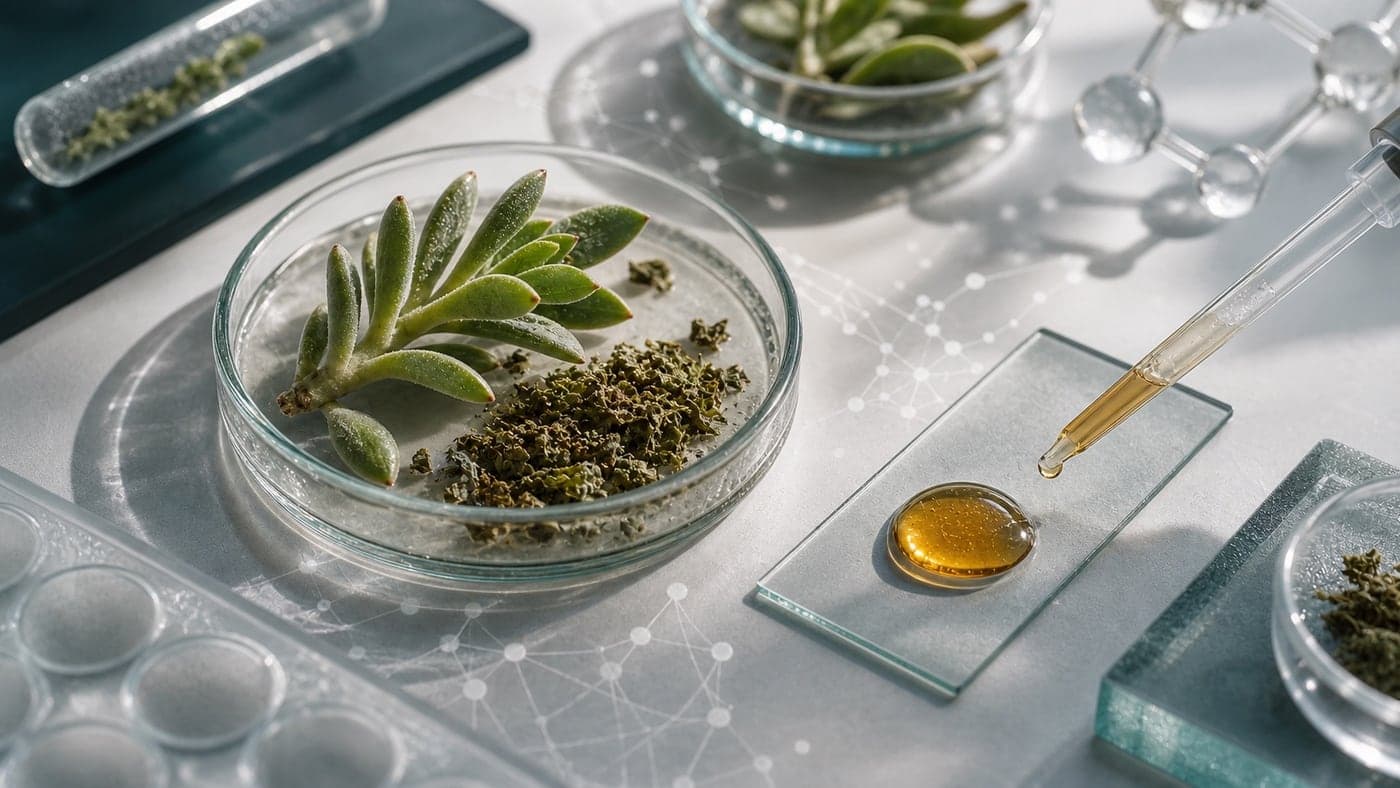
When people talk about how Kanna works, they usually talk about alkaloids. The names you will see most often include mesembrine, mesembrenone, mesembrenol and related compounds.
The short version is this: some Sceletium alkaloids and standardized extracts have been studied for activity related to serotonin reuptake and PDE4. That is one reason Kanna gets discussed as a mood and stress-related botanical.
The careful version is more important:
- Studied extracts are not the same as every consumer product.
- A standardized extract is not the same as loose plant material.
- A drink with an undisclosed blend is not the same as a research preparation.
- Mechanism does not prove a guaranteed consumer outcome.
- More technical language does not make a product better.
This guide will explain the science in plain English, but it will not pretend that a mechanism diagram proves that every Kanna product will work for every person.
What the research actually supports
The most useful way to read Kanna research is to keep the scope narrow.
There is evidence that specific standardized Sceletium extracts have been studied in humans and in lab contexts. Some of that research is interesting for mood, stress, cognition and brain-response questions. But the human evidence remains limited, and it should not be stretched into broad promises about every drink, chew, tincture, powder, tea or supplement on the market.
A good Kanna claim should answer three questions:
- Was the claim studied in humans, animals, cells or only inferred from mechanism?
- Was the product a standardized extract, raw plant material or a commercial drink blend?
- Does the claim apply to this exact product, or only to Kanna as a general category?
If a brand skips those details and jumps straight to big promises, be skeptical.
What Kanna is not
Kanna is not alcohol.
It is not cannabis.
It is not MDMA.
It is not a cure for anxiety, depression, pain, sleep problems, alcohol use or social discomfort.
It is not automatically safe because it is a plant.
It is not automatically effective because it has traditional use.
It is not automatically trustworthy because it appears in a premium can.
This may sound strict, but it makes the guide more useful. Once the hype is stripped away, Kanna is still interesting. It just becomes easier to see what is actually being claimed.
Product label basics

Before you evaluate a Kanna product, look for the basics:
- Does the label clearly say Kanna or Sceletium tortuosum?
- Does it disclose the serving size?
- Does it name the extract type or standardization?
- Does it list other active ingredients?
- Does it provide third-party testing or a certificate of analysis?
- Does the brand avoid disease-treatment claims?
- Does the product explain what role Kanna plays in the formula?
This matters because the Kanna market includes a mix of clear labels, vague blends, stale retailer descriptions and products that may be mood-focused without actually containing Kanna.
The product guide, Best Kanna Drinks, should be treated as a verification-first shortlist, not as proof that every functional or euphoric drink contains Kanna.
The practical definition
If you only remember one paragraph, make it this one:
Kanna is Sceletium tortuosum, a South African succulent now sold in modern drink and supplement formats. Some standardized extracts have research behind them, but the evidence is limited and product quality varies. Treat Kanna as a psychoactive botanical. Verify labels carefully and read the safety chapter before trying a product.
Read next
Go back to the full Kanna Guide if you want the book overview.
Read Is Kanna Safe? before trying any product, especially if you take antidepressants, MAOIs, stimulants, sedatives, MDMA or other mood-affecting substances.
Read Does Kanna Get You High? if your main question is what Kanna may feel like.
Read Kanna Drinks vs Powder vs Chews if you are comparing formats.