
Yes, Kanna can be made into tea.
That does not make it the easiest, clearest or most predictable way to use Kanna.
Kanna is the common name for Sceletium tortuosum, a South African plant also known as channa or kougoed. OPSS notes that traditional use has included chewing, smoking and making the plant into tea. That history is real. It is also not a guarantee that every modern pouch, powder, extract or tea product is appropriate, well labeled or right for you.
The careful answer is this:
Kanna tea is a DIY preparation of a mood-active botanical. Treat it like a supplement decision, not like a casual cup of chamomile.
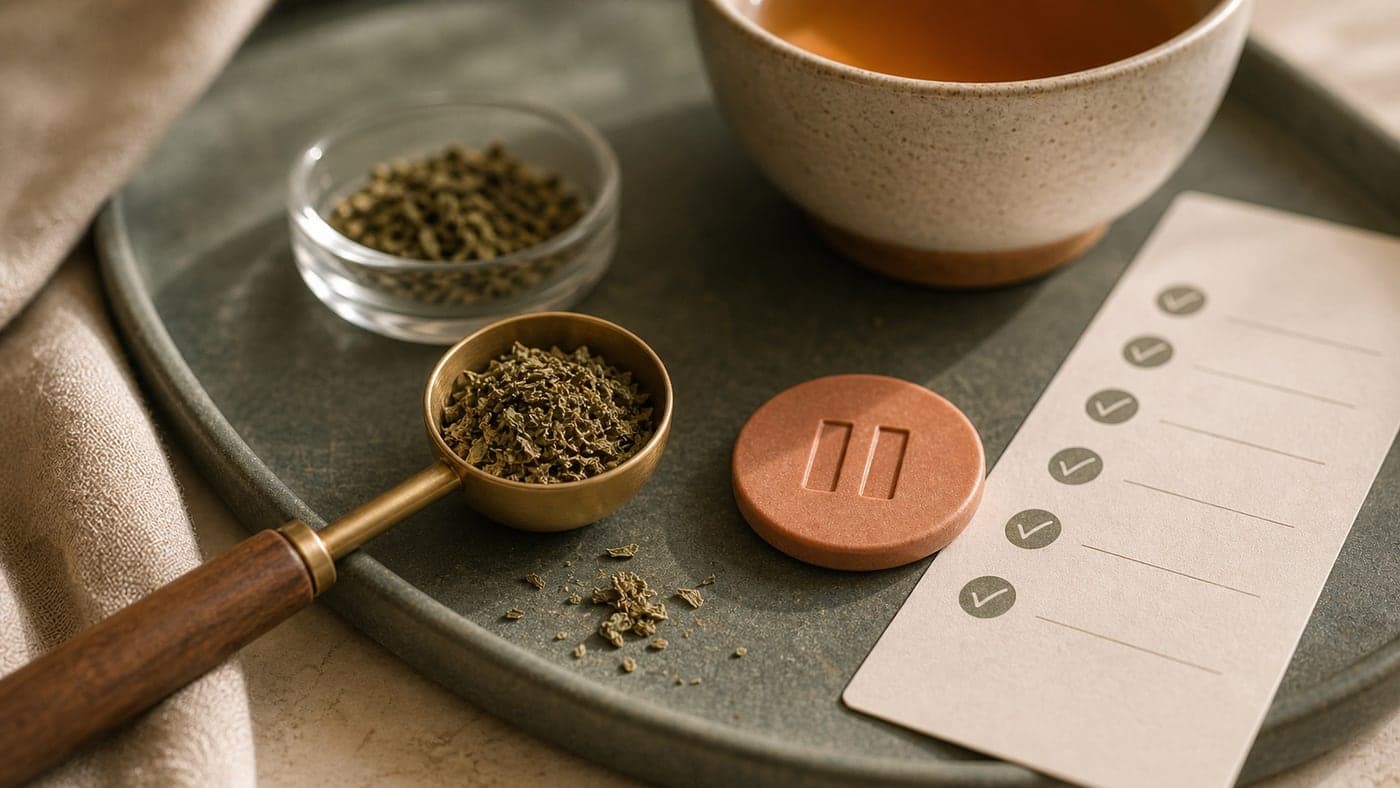
The short answer
If you are trying to make Kanna tea, start with safety and product quality before technique.
The basic, conservative framework is:
- Use only a clearly labeled product that says Kanna or Sceletium tortuosum.
- Use only a product meant to be swallowed.
- Follow the product's own preparation directions when they exist.
- Do not turn a concentrated extract into tea unless the label specifically says it is meant for that use.
- Do not chase a stronger effect by adding more plant material.
- Strain loose plant matter carefully.
- Do not combine Kanna casually with antidepressants, MAOIs, MDMA or other mood-affecting substances.
- Stop if you feel headache, stomach problems, fatigue, drowsiness, concentration problems, anxiety or any unusual reaction.
This chapter does not give an exact serving protocol. Kanna products vary too much, and the safer consumer move is to evaluate the specific label rather than copy a generic internet recipe.
Read Is Kanna Safe? before trying Kanna tea.
What Kanna tea is
Kanna tea is usually discussed in one of two ways.
The traditional frame is simple: Sceletium plant material prepared in a way that can be chewed or made into tea.
The modern consumer frame is more complicated: loose plant material, powders, extracts, drink mixes, tinctures and supplement products all using the Kanna name with different levels of label clarity.
Those are not the same thing.
A tea bag labeled with Kanna is not the same as loose fermented plant material. Loose plant material is not the same as a standardized extract. A standardized extract is not the same as a canned drink or chew. A vague "mood blend" is not the same as a transparent Sceletium product with a Supplement Facts panel and testing.
The word tea can make Kanna sound gentle. That is why the product-quality check matters.
Before you try Kanna tea
Pause before making Kanna tea if any of these apply:
- You take an SSRI, SNRI, MAOI, MDMA, stimulant, sedative, psychiatric medication or another mood-affecting substance.
- You are pregnant, trying to become pregnant or breastfeeding.
- You have a history of severe anxiety, panic, mania, psychosis, seizures or complex psychiatric care.
- You need to drive, work, care for children, exercise hard or do anything safety-sensitive afterward.
- You are subject to military, workplace, athletic or legal restrictions.
- The product label does not clearly say what form of Kanna is being used.
- The seller relies on effect promises instead of ingredient and testing information.
If you take medication or have a medical condition, bring the exact product label to a qualified clinician. A tea guide cannot clear an interaction risk.
What to use
Use the clearest product you can find.
For a tea-style preparation, that means a product that answers these questions:
- Does it clearly say Kanna, channa, kougoed or Sceletium tortuosum?
- Is it meant to be swallowed?
- Is it sold as loose plant material, a tea product, a powder or another ingestible format?
- Does the label give preparation directions?
- Does it list other active ingredients?
- Does it disclose serving size in plain language?
- Does the seller provide current third-party testing or a certificate of analysis?
- Does the product avoid disease-treatment claims and intoxication-first marketing?
Avoid products that make you guess.
That includes vague mood blends, products sold mainly around a strong euphoric hit, products promoted for inhaled or nasal use and concentrated extracts with no clear preparation instructions.
What not to do
Do not treat Kanna tea like a kitchen chemistry project.
Exact heat targets, acidity tweaks, serving ranges and extraction talk push readers toward optimization instead of evaluation. That is the wrong emphasis for a consumer guide.
The guardrails are simpler:
- Do not use unlabeled plant material.
- Do not use products meant for vaping or nasal use.
- Do not assume stronger is better.
- Do not mix several Kanna formats in the same sitting.
- Do not combine Kanna with alcohol to test the effect.
- Do not combine Kanna with antidepressants or other mood-affecting substances casually.
- Do not use DIY tea as a treatment for anxiety, depression, sleep, pain, alcohol use or any medical condition.
If the product does not give basic preparation directions, that is not an invitation to improvise. It is a reason to skip it or ask the seller for better documentation.
A conservative preparation framework
If you still choose to make Kanna tea, keep the process boring.
Start with a clearly labeled ingestible Kanna product. Read the label first. If the label gives preparation directions, use those directions rather than a generic recipe.
Use hot water, not a rolling-boil experiment. Keep the preparation gentle and avoid turning it into an extraction project. If the product is loose plant material, let it steep, then strain carefully so you are not drinking grit or sediment.
Use a clean mug, clean strainer and clean workspace. Do not prepare Kanna tea in equipment used for chemicals, concentrates or other substances.
Keep the rest of the cup simple. Adding honey, ginger, lemon, mint or another ordinary flavoring may help taste, but it does not remove the safety questions. Flavor masking is not risk management.
Do not stack Kanna tea with other functional products to create a stronger experience. If you are comparing formats, read Kanna Drinks vs Powder vs Chews before mixing formats.
Taste and texture
Kanna tea is not famous for tasting like a polished beverage.
Many people describe raw or loose Kanna preparations as earthy, bitter, salty, vegetal or gritty. Some people tolerate that. Some people do not. The taste can also change by product, preparation, plant material and added flavoring.
That matters because taste shapes behavior.
If a tea tastes harsh, readers may be tempted to add more sweetener, combine it with another drink or switch products quickly. That can make it harder to tell what is causing an effect or side effect.
The better response is not to force the cup. The better response is to treat unpleasant taste, unclear label information or a strange reaction as useful feedback.
Kanna tea is not a moral test. If the product is unpleasant or unclear, you can skip it.
Why DIY Kanna tea is hard to standardize
DIY Kanna tea has a consistency problem.
The plant material can vary. The product format can vary. The label can vary. Preparation can vary. Human response can vary.
OPSS notes that human studies have been small and short-term, and that some have used the standardized ingredient Zembrin rather than the wide range of consumer products sold as Kanna. OPSS also reports side effects and product adulteration concerns.
That means you should not stretch standardized-extract research across every homemade tea.
Fermentation adds another layer. Research on kougoed preparation has found that fermentation can change the profile of prominent Sceletium alkaloids. That is useful background. It does not prove that a consumer pouch labeled "fermented" is safer, stronger or more predictable.
This is the central problem with DIY Kanna tea:
The more control you want, the more you need product-specific information. The more vague the product is, the less a recipe can solve.

Tea vs Kanna drinks
Kanna tea can appeal to readers who want a plant-forward, DIY ritual.
Kanna drinks can appeal to readers who want a social beverage format.
Neither format is automatically safer.
Tea can be harder to standardize because loose plant material and preparation vary. Drinks can be easier to use socially but may include other active ingredients, sweeteners, caffeine, hemp-derived ingredients, adaptogens or proprietary blends.
The same checklist applies either way:
- Does the product clearly disclose Kanna or Sceletium tortuosum?
- Does it explain the serving?
- Does it list every active ingredient?
- Does it provide current testing?
- Does it avoid treatment claims and exaggerated effect promises?
- Does it fit your medication, workplace, legal and personal context?
Use Best Kanna Drinks as a verification-first shortlist if you decide DIY tea is not the right format.
When to skip DIY Kanna tea
Skip DIY Kanna tea when the risk-to-clarity ratio is bad.
That means skipping when:
- The label is vague.
- The product is not clearly meant to be swallowed.
- The product is a concentrated extract with no tea instructions.
- The seller makes disease-treatment, cure or guaranteed-effect claims.
- There is no current testing information.
- You are taking medication that could interact.
- You are trying to use Kanna for a medical purpose.
- You need a predictable social drink experience.
- You feel pressure to make the tea stronger because the first cup is subtle.
Kanna is not urgent. If the product does not earn trust, wait.
Kanna Tea Checklist
Before making Kanna tea, ask:
- Is this actually Kanna or Sceletium tortuosum?
- Is it an ingestible product?
- Does the label tell me how it is meant to be prepared?
- Does it list every active ingredient?
- Does it provide current third-party testing?
- Am I avoiding risky medication and substance combinations?
- Am I avoiding safety-sensitive tasks afterward?
- Am I prepared to stop if I notice side effects?
- Am I using this as an alcohol-free ritual, not as a medical treatment?
If several answers are unclear, do not make the tea.
The practical verdict
Kanna tea is possible, but possible is not the same as ideal.
It can be a traditional-feeling DIY ritual for readers who have a clearly labeled product, understand the safety cautions and accept that the result may be inconsistent.
It is not the right format for readers who want predictable social sipping, medical self-treatment, strong effects or a shortcut around product-quality questions.
The safest version of this chapter is not a precise recipe. It is a filter.
Use it to reject unclear products, risky combinations and effect-chasing instructions. If a Kanna tea product still looks reasonable after that filter, follow the product label, keep the preparation simple and move slowly.
Read next
Read Is Kanna Safe? before trying Kanna tea.
Read Kanna Drinks vs Powder vs Chews if you are comparing Kanna formats.
Read Kanna vs Alcohol if your main interest is sober-curious ritual.
Use Best Kanna Drinks as a verification-first shortlist if you want a drink format instead of DIY tea.
Go back to the full Kanna Guide for the complete chapter list.
Sources
- OPSS, Kanna uses and safety
- FDA, questions and answers on dietary supplements
- PubMed, Investigations of the phytochemical content of Sceletium tortuosum following the preparation of "Kougoed" by fermentation of plant material
- ScienceDirect, Investigations of the phytochemical content of Sceletium tortuosum following the preparation of "Kougoed" by fermentation of plant material