
Non-Alcoholic Drinks and Sleep: What Actually Helps at Night
Non-alcoholic drinks for sleep: how evening alcohol fragments rest, hidden caffeine and sugar traps, and which nightcap ingredients have real research.
A nightcap is supposed to help you sleep. A late beer or glass of wine can make you drowsy, and that drowsiness is real. The night that follows is often worse: you may fall asleep faster, then spend the second half of the night more fragmented, with less REM sleep and, sometimes, more snoring.
Switching that last drink to something non-alcoholic removes the ethanol trade-off. It does not automatically make the drink sleep-friendly. Caffeine can hide in tea mocktails, mate, guayusa, espresso builds and some "calm" cans. A sweet dessert mocktail can sit heavy, and a large, very fizzy or acidic glass right before bed can send you to the bathroom or make reflux more likely once you lie down.
A quick note: this is an unranked explainer, not a product ranking and not medical advice. Nobody paid to be mentioned, and we do not score, price or recommend cans here. For our current ranked picks, see best drinks for sleep and best functional beverages. If you have ongoing insomnia, snoring or a sleep disorder, or you take prescription medicines, talk with a clinician rather than treating a drink as care.
TL;DR
- Evening alcohol is a poor sleep strategy. It can make you sleepy at first, but it delays and reduces REM sleep even at about two standard drinks, and it can leave the second half of the night more disrupted.
- It can also affect breathing. Alcohol relaxes throat muscles, and a meta-analysis found worse apnea scores and lower oxygen levels, especially in people who already snore or have sleep apnea.
- A non-alcoholic nightcap is not automatically sleep-friendly. Caffeine, a heavy load of evening sugar, and a large late volume of fluid or fizz can each work against a solid night.
- A few ingredients have modest human data, not miracle claims. Chamomile, tart cherry, magnesium, L-theanine and hop-rich non-alcoholic beer appear in small trials. The effects are usually modest, and the label dose may not match the research.
- Timing matters as much as the ingredients. Keep caffeine out of the late afternoon and evening, ease up on very sweet or acidic drinks before you lie down, and taper fluids so the last sip is a small wind-down, not a pint.
Why cutting evening alcohol changes sleep architecture
Alcohol is a sedative, which is why the nightcap habit exists. A 2013 review by Ebrahim and colleagues, looking at controlled studies in healthy adults, found that alcohol shortened the time it took to fall asleep, made the first half of the night more consolidated, and increased disruption in the second half. It also delayed the first REM period at every dose studied, and, at moderate and high doses, reduced the share of REM sleep across the night. REM is the stage most closely tied to memory and emotional processing, which is one reason a "heavy sleep" after drinks can still leave you unrefreshed.
A 2025 meta-analysis by Gardiner and colleagues, covering 27 controlled studies, sharpened that picture. REM started later and lasted less even after a low dose of alcohol, which the authors described as 0.50 grams per kilogram or less, or about two standard drinks, and the disruption grew as the dose rose. A clear shortening of sleep onset, and of the time it took to reach deep N3 sleep, appeared only after a high dose, about five standard drinks. The dose that most reliably knocks you out is also the dose most likely to scramble REM. Effects on total sleep time, sleep efficiency and time spent awake after sleep onset were too uncertain to pin down.
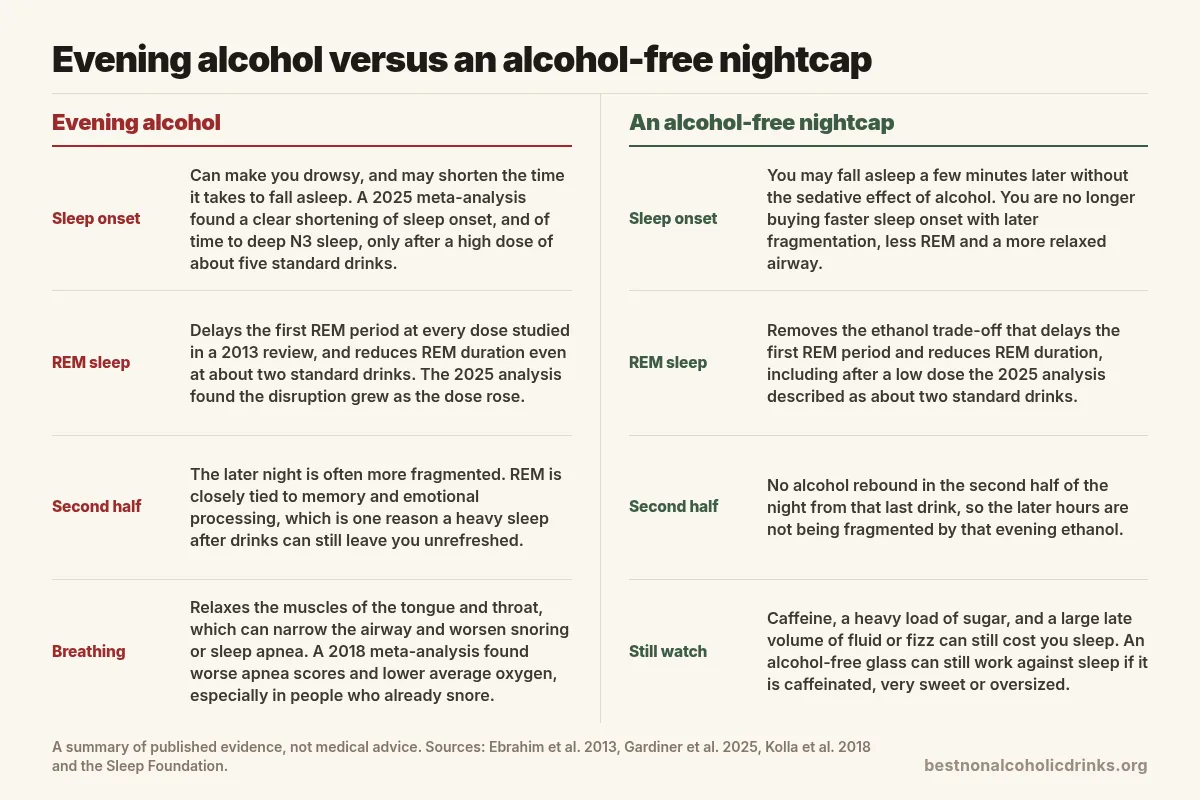
Breathing is a separate issue. Alcohol relaxes the muscles of the tongue and throat, which can narrow the airway. The Sleep Foundation notes that drinking before bed can worsen snoring and sleep apnea, and recommends leaving three to four hours between alcohol and bedtime. A 2018 meta-analysis by Kolla and colleagues found worse apnea-hypopnea scores and lower average oxygen levels during sleep, especially in people who already snore or have sleep apnea.
That is why cutting an evening drink can change the night, even if you fall asleep a few minutes later without it. You are no longer buying faster sleep onset with later fragmentation, less REM and a more relaxed airway. For a broader look at what happens when you drink less, see benefits of drinking less. If you are mapping a month off, our Dry January guide is a practical starting point.
Hidden sleep disruptors inside non-alcoholic drinks
Zero-proof is not the same as sleep-proof. Three common features of evening NA drinks can still cost you sleep.
Caffeine in tea, mate and "calm" cans
Black, green and oolong tea, yerba mate, guayusa and espresso mocktails all contain caffeine. So do some botanical or functional cans marketed for calm or balance, especially if the label includes green tea extract, guayusa, yerba mate or guarana.
FDA cites 400 milligrams a day as an amount not generally associated with negative effects for most healthy adults, and notes that sensitivity varies widely. Timing matters as much as the daily total. Caffeine's half-life in healthy adults can range from about two to ten hours, which is why a late drink catches some people and not others.
In a 2013 home study, Drake and colleagues found that 400 milligrams of caffeine cut total sleep time by a little more than an hour versus placebo, even when it was taken six hours before bed. A 2023 meta-analysis by Gardiner and colleagues estimated that a typical cup of coffee, 107 milligrams in 250 milliliters, should be finished at least 8.8 hours before bed to avoid a loss of total sleep time, and that a 217.5-milligram pre-workout serving needed about 13.2 hours. A modest cup of black tea had no clear cutoff in that model, but that finding does not extend to a strong brew, a mate pour or an espresso mocktail.
If a nightcap is meant to help you sleep, keep caffeinated teas, mate, guayusa and coffee-based mocktails out of the evening, and read the back of any "relax" can for hidden caffeine.
Heavy evening sugar
Sweet mocktails, syrupy sodas and dessert-style builds can pack a lot of added sugar into one glass. The Sleep Foundation notes that diets high in added sugar may contribute to poor sleep, and that sugary drinks before bed are worth avoiding if nighttime bathroom trips are a problem. A heavy, very sweet nightcap can also sit uncomfortably, especially if you are prone to reflux. For lighter evening builds, see our healthy low-sugar mocktail recipes.
Late-night fluid volume, fizz and acid
Even a caffeine-free, low-sugar drink can interrupt sleep if you drink a lot of it right before bed. Waking more than once to urinate is called nocturia, and the Sleep Foundation notes that drinking too much before bed contributes to it. Its advice is to reduce evening fluids and to avoid alcohol, caffeine and sugary drinks before sleep.
A very fizzy or citrus-heavy drink right before you lie down can also feel uncomfortable, and nighttime reflux is already more likely once you are flat. The Sleep Foundation advises leaving about two hours after eating to reduce nighttime acid reflux. Keep the last glass modest, and leave a little time between the last sip and the pillow.
What evening ingredients have real human research
This is the part of the label that marketing usually oversells. A few nightcap ingredients have been studied in people. The trials are often small, the effects are usually modest, and a can or tea is not the same product that was tested in a clinic. NCCIH also notes that store-shelf supplements can differ from the products used in research.
Chamomile
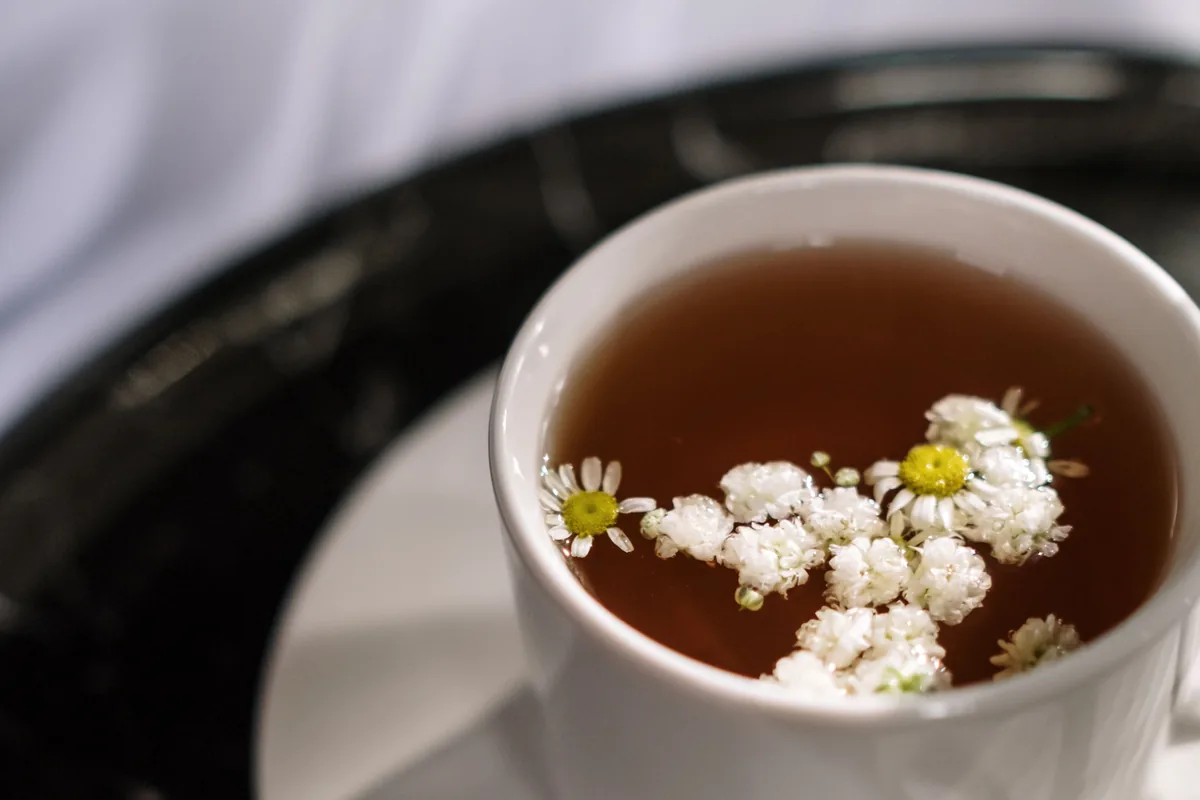
Chamomile is the classic bedtime tea, and apigenin, a flavonoid in the flower, is the compound most often named in that tradition. The clinical picture is more cautious than the reputation. NCCIH says there is very little reliable information on chamomile for insomnia, and that a 2019 review found one insomnia study, which showed no benefit. That study, a 2011 randomized pilot by Zick and colleagues in 34 adults with chronic primary insomnia, used a standardized extract rather than a cup of tea and found no significant differences versus placebo on sleep-diary measures.
A 2024 meta-analysis by Kazemi and colleagues, including 10 trials and 772 adults, found a modest improvement in Pittsburgh Sleep Quality Index scores, about 1.9 points, with high variation among the trials. Sleep duration, sleep efficiency and daytime function did not improve. If you are allergic to ragweed, chrysanthemums, marigolds or daisies, you are more likely to react to chamomile. NCCIH also notes reported interactions with warfarin and with some drugs metabolized by the liver, and theoretical reasons to be careful with sedatives.
Tart cherry, usually Montmorency
Montmorency tart cherries contain melatonin and polyphenols, including procyanidins. In 2012, Howatson and colleagues asked 20 healthy adults to drink 30 milliliters of tart cherry juice concentrate twice a day for seven days. Urinary melatonin rose, and actigraphy showed more total sleep time and higher sleep efficiency than placebo. An earlier 2010 pilot by Pigeon and colleagues, in 15 older adults with insomnia, found a reduction in insomnia severity and time spent awake after sleep onset versus placebo, but not in sleep onset, total sleep time or sleep efficiency. A 2018 pilot by Losso and colleagues, in eight adults over 50 with insomnia, found about 84 more minutes of sleep on polysomnography after 240 milliliters twice a day, and reported preliminary lab findings on cherry procyanidin B-2 and tryptophan.
Tart cherry has some of the cleaner sleep data in this group, and it is still early, small and mixed. If you use a juice or blend, check added sugar.
Magnesium
Magnesium is an essential mineral, often sold in sleep drinks as glycinate, citrate or L-threonate. It is a real nutrient, not a proven cure for insomnia. In a 2012 trial by Abbasi and colleagues, 46 older adults with primary insomnia took 500 milligrams of magnesium or a placebo daily for eight weeks, and diary measures of insomnia, sleep onset, sleep time and sleep efficiency improved. A 2021 meta-analysis by Mah and Pitre, pooling three randomized trials in 151 older adults, found sleep onset about 17 minutes shorter with magnesium than placebo. Total sleep time rose by about 16 minutes, a change that was not statistically significant. The authors rated the evidence as low to very low quality, with moderate-to-high risk of bias.
NIH's Office of Dietary Supplements sets the tolerable upper intake level for magnesium from supplements and medications at 350 milligrams a day for adults, not counting magnesium from food. High supplemental doses can cause diarrhea, nausea and cramping. The 500-milligram dose in the Abbasi trial is above that upper limit, which is one more reason not to copy a study dose off a drink label. If you already take a magnesium supplement, count the drink toward the same daily total.
L-theanine
L-theanine is an amino acid found in tea, often added to evening drinks because it is associated with a calmer state, especially when caffeine is also in the cup. In a 2019 randomized crossover trial, Hidese and colleagues asked 30 healthy adults to take 200 milligrams of L-theanine or a placebo before bed for four weeks. Sleep-quality scores improved, and sleep-latency and sleep-disturbance subscales were better on L-theanine than on placebo. The trial was short, the group was small, and it was funded by Taiyo Kagaku, the company that supplied the tablets; two of the authors are employees of that company. A 2025 meta-analysis by Payne and colleagues found mixed sleep results across tea and L-theanine trials, with clearer short-term attention data when L-theanine was paired with caffeine. Two of those authors are affiliated with Lipton / Unilever. L-theanine may help some people feel more settled at night, but it is not a knockout sedative, and a can that also contains caffeine is a different drink.
Lemon balm and hops, and the non-alcoholic beer question
This is the usual home for "does non-alcoholic beer help you sleep?" In a 2012 PLOS ONE study, Franco and colleagues asked 17 female nurses who worked rotating or night shifts, and who reported a high load of work stress, to drink 333 milliliters of a non-alcoholic beer described as 0.0% alcohol, with supper, for 14 days. Compared with a control week with no beer, sleep latency fell from about 20.5 minutes to about 12 minutes, and nighttime activity was lower. The study was small, it included only women in a stressed, shift-working group, and the control was a week without beer, not a hop-free placebo. It is a genuine signal, and it is much too thin to treat non-alcoholic beer as a sleep aid.
Many non-alcoholic beers sold in the United States can contain up to just under 0.5% alcohol by volume unless the label says 0.0%. That is not enough to recreate a standard drink's effect on REM sleep, but it is not the same as a 0.0% label either. For a plain-English guide to those words, see dealcoholized vs. non-alcoholic vs. alcohol-free. Lemon balm has more human data for anxiety than for sleep. A 2021 meta-analysis by Ghazizadeh and colleagues found lower anxiety and depression scores versus placebo, with high variation and a small number of trials.
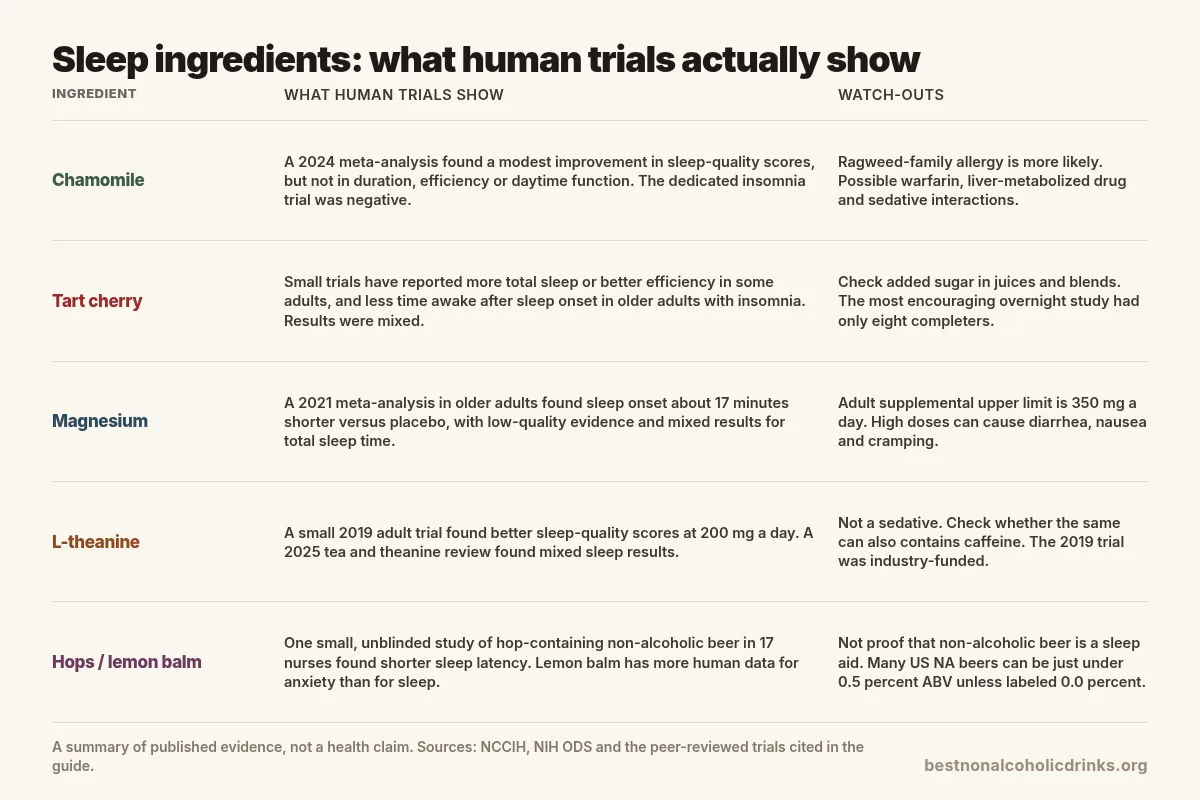
| Ingredient | What human evidence says | Watch-outs |
|---|---|---|
| Chamomile | A 2024 meta-analysis found a modest improvement in sleep-quality scores, but not in sleep duration, efficiency or daytime function. The dedicated insomnia trial was negative, and NCCIH still finds little reliable insomnia evidence. | Ragweed-family allergy; possible interactions with warfarin, some liver-metabolized drugs and sedatives. A supermarket tea is not the extract used in most trials. |
| Tart cherry (Montmorency) | Small trials have reported more total sleep or better efficiency in healthy adults, and less time awake after sleep onset in older adults with insomnia. Samples were small and results were mixed. | Check added sugar in juices and blends. The most encouraging overnight study had only eight completers. |
| Magnesium | A 2021 meta-analysis in older adults found sleep onset about 17 minutes shorter versus placebo, with low-quality evidence and mixed results for total sleep time. | Adult supplemental upper limit is 350 milligrams a day; high doses can cause diarrhea, nausea and cramping. Count a drink toward the same daily total. |
| L-theanine | A small 2019 adult trial found better sleep-quality scores at 200 milligrams a day. A 2025 tea and theanine review found mixed sleep results. | Not a sedative. Check whether the same can also contains caffeine. The 2019 trial was funded by a theanine manufacturer. |
| Hops and lemon balm | One small, unblinded study of hop-containing non-alcoholic beer in 17 nurses found shorter sleep latency. Lemon balm has more human data for anxiety than for sleep. | Not proof that non-alcoholic beer is a sleep aid. Many US non-alcoholic beers can contain just under 0.5 percent ABV unless labeled 0.0 percent. |
Label reality: blends, fairy dusting and medications
A trial result is not a promise about your can. On a Supplement Facts panel, a company can group ingredients as a proprietary blend, list the total weight, and keep the amount of each ingredient to itself. That is how a "sleep blend" can contain a research-sounding list and still deliver only a sprinkle of the ingredients that were actually studied, a practice sometimes called fairy dusting.
FDA does not approve dietary supplements for safety or effectiveness before they are sold. If you take prescription sedatives, blood thinners such as warfarin, or other daily medications, run the ingredient list past a clinician or pharmacist. Chamomile is one example, not the only one, of a calming herb that can interact with medicines.
A practical evening playbook
You do not need a specialized sleep can to have a useful nightcap. You need a drink that does not fight the night, poured at a time that leaves you ready for bed.
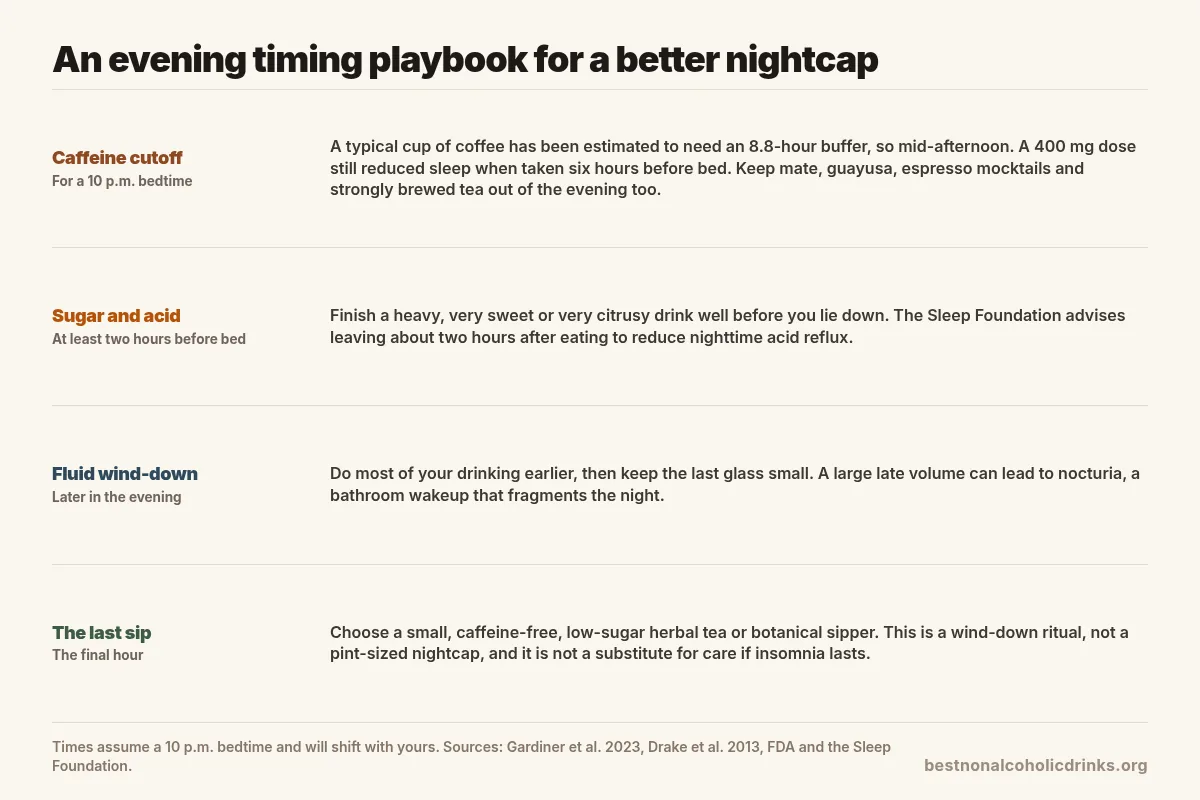
Set a caffeine cutoff first. For a coffee-strength serving, the Gardiner 2023 model points to a buffer of about 8.8 hours before bed. For a 400-milligram dose, Drake's study still found a large sleep loss six hours before bed. Keep coffee, espresso mocktails, mate, guayusa and strongly brewed tea out of the late afternoon and evening, and give yourself more room if you are caffeine-sensitive. A "calm" can still needs a caffeine check.
Keep the last sweet or acidic drink away from the pillow. Leave a couple of hours between a heavy, very sweet or very citrusy drink and lying down, especially if reflux wakes you.
Taper fluids in the last part of the evening. Stay hydrated earlier in the day, then make the last drink small. If you already wake to use the bathroom, this is often the highest-yield change.
Choose a warm herbal or a chilled low-sugar sipper. A caffeine-free chamomile or lemon balm tea is a reasonable classic. A small tart cherry drink, unsweetened or only lightly sweetened, is a reasonable colder option. A hop water or a modest non-alcoholic beer can scratch the ritual itch of a last pour, with the label caveats above. For commercial sleep drinks, use best drinks for sleep as the ranked shortlist, not as a promise that any can will put you to sleep.
Treat insomnia as a medical issue when it lasts. A thoughtful nightcap can be part of a wind-down. It is not a substitute for care if you have ongoing trouble sleeping, loud snoring, or a diagnosed sleep disorder.
FAQ
Does non-alcoholic beer help you sleep?
Not in a way you can count on. One small 2012 study found shorter sleep latency in 17 stressed female nurses who drank a hop-containing beer labeled 0.0% alcohol with supper, compared with a week of no beer. It was not a blinded placebo test, and it has not established non-alcoholic beer as a sleep aid. If you enjoy one as a ritual, watch the sugar and volume, and check whether the label says 0.0% or just under 0.5% ABV.
How early should I stop drinking fluids before bed?
There is no single clock time that works for everyone. Do most of your drinking earlier in the evening, then keep the last glass small. The Sleep Foundation advises reducing evening fluids to lower the chance of nocturia, and leaving about two hours after eating if nighttime reflux is a problem. If you still wake to urinate after cutting back, talk with a clinician.
Can a drink marketed for calm or sleep still contain caffeine?
Yes. Green tea extract, guayusa, yerba mate and guarana all bring caffeine, and they can show up in cans with relaxing language on the front. If the label does not state a caffeine amount and you want to sleep, skip it at night.
Why do I fall asleep after a drink and still wake up at 3 a.m.?
Alcohol can make you drowsy and, at higher doses, help you fall asleep faster. As it wears off, the second half of the night tends to be more disrupted, and REM sleep is delayed and reduced even at about two standard drinks. The 3 a.m. wakeup is often that rebound, not a sign that you needed a second drink.
Do magnesium or tart cherry drinks replace treatment for insomnia?
No. The magnesium evidence is modest and low-quality, mostly in older adults. Tart cherry trials are small and mixed. Neither is a substitute for medical care, and neither should be stacked with prescription sedatives or other daily medicines without a clinician's advice.
What should I look for on a sleep-drink label?
Look for a stated caffeine amount, or for caffeinated ingredients, even on a calm can. Check added sugars. Prefer labels that list each active ingredient in milligrams, not a proprietary blend. If the drink is a non-alcoholic beer, check whether the alcohol statement is 0.0% or under 0.5% ABV. If you take regular medications, take the ingredient list to a pharmacist.
Sources
- Irshaad O. Ebrahim, Colin M. Shapiro, Adrian J. Williams and Peter B. Fenwick, "Alcohol and Sleep I: Effects on Normal Sleep," Alcoholism: Clinical and Experimental Research 37(4) (2013), 539-549. At all doses studied, alcohol shortened sleep onset, increased second-half sleep disruption and delayed the first REM period; total-night REM sleep decreased in most studies at moderate and high doses. PubMed 23347102
- Carissa Gardiner, Jonathon Weakley, Louise M. Burke, Gregory D. Roach, Charli Sargent, Nirav Maniar, Minh Huynh, Dean J. Miller, Andrew Townshend and Shona L. Halson, "The effect of alcohol on subsequent sleep in healthy adults: A systematic review and meta-analysis," Sleep Medicine Reviews 80 (2025), 102030. In 27 controlled studies, REM onset was delayed and REM duration reduced in a dose-dependent way, including after a low dose described as about two standard drinks; shorter sleep onset and shorter time to deep sleep were clear only after a high dose of about five standard drinks. PubMed 39631226
- Bhanu Prakash Kolla, Moein Foroughi, Farzane Saeidifard, Subhajit Chakravorty, Zhen Wang and Meghna P. Mansukhani, "The Impact of Alcohol on Breathing Parameters during Sleep: A Systematic Review and Meta-analysis," Sleep Medicine Reviews 42 (2018). Alcohol worsened the apnea-hypopnea index and lowered average oxygen levels during sleep, especially in people with obstructive sleep apnea or a history of snoring. PubMed 30017492
- Sleep Foundation, "Alcohol and Sleep." Alcohol can make you feel sleepy at first but leads to lighter, more fragmented sleep and less REM; it can worsen snoring and sleep apnea by relaxing throat muscles; experts recommend avoiding alcohol within three to four hours of bedtime. sleepfoundation.org
- Sleep Foundation, "The Link Between Alcohol and Sleep Apnea." Drinking before bed can relax the tongue and throat and worsen obstructive sleep apnea. sleepfoundation.org
- FDA, "Spilling the Beans: How Much Caffeine Is Too Much?" FDA cites 400 milligrams a day for most adults as an amount not generally associated with negative effects; sensitivity varies widely. fda.gov
- Christopher Drake, Timothy Roehrs, John Shambroom and Thomas Roth, "Caffeine effects on sleep taken 0, 3, or 6 hours before going to bed," Journal of Clinical Sleep Medicine 9(11) (2013), 1195-1200. A 400-milligram caffeine dose reduced total sleep time by a little more than an hour versus placebo when taken at bedtime, 3 hours before bed or 6 hours before bed. PMC3805807
- Carissa Gardiner, Jonathon Weakley, Louise M. Burke, Gregory D. Roach, Charli Sargent, Nirav Maniar, Andrew Townshend and Shona L. Halson, "The effect of caffeine on subsequent sleep: A systematic review and meta-analysis," Sleep Medicine Reviews 69 (2023), 101764. Caffeine reduced total sleep time by about 45 minutes and sleep efficiency by 7 percent; a typical 107-milligram cup of coffee was estimated to need an 8.8-hour buffer before bed, while caffeine's half-life can range from about two to ten hours. PubMed 36870101
- Sleep Foundation, "Nutrition and Sleep." Diets high in saturated fat and added sugar may contribute to poor sleep; avoiding eating in the two hours before bed may help reduce nighttime acid reflux. sleepfoundation.org
- Sleep Foundation, "How Drinking Water Before Bed Impacts Sleep." Drinking too much water before bed contributes to nocturia; reducing evening fluid intake and avoiding alcohol, caffeine and sugary drinks before sleep can lower the chance of nighttime bathroom trips. sleepfoundation.org
- NCCIH, "Chamomile: Usefulness and Safety." Very little information on chamomile for insomnia; a 2019 review found one insomnia study, which showed no benefit; allergy is more likely with ragweed-family plants; possible interactions with warfarin, some liver-metabolized drugs and sedatives. nccih.nih.gov
- Suzanna M. Zick, Benjamin D. Wright, Ananda Sen and J. Todd Arnedt, "Preliminary examination of the efficacy and safety of a standardized chamomile extract for chronic primary insomnia: A randomized placebo-controlled pilot study," BMC Complementary and Alternative Medicine 11 (2011), 78. In 34 adults with chronic primary insomnia, a standardized chamomile extract produced no significant differences versus placebo on sleep-diary measures. PMC3198755
- Asma Kazemi, Sara Shojaei-Zarghani, Parham Eskandarzadeh and Mohammad Hashem Hashempur, "Effects of chamomile (Matricaria chamomilla L.) on sleep: A systematic review and meta-analysis of clinical trials," Complementary Therapies in Medicine 84 (2024), 103071. Across 10 trials and 772 adults, chamomile improved sleep-quality scores, with high heterogeneity, but did not improve sleep duration, sleep efficiency or daytime function. PubMed 39106912
- Glyn Howatson, P.G. Bell, J. Tallent, Benita Middleton, Malachy P. McHugh and Jason Ellis, "Effect of tart cherry juice (Prunus cerasus) on melatonin levels and enhanced sleep quality," European Journal of Nutrition 51(8) (2012), 909-916. In 20 healthy adults, 30 milliliters of tart cherry concentrate twice daily for seven days raised urinary melatonin and improved actigraphic total sleep time and sleep efficiency versus placebo. Initials for Bell and Tallent follow the PubMed record, to avoid inventing first names. PubMed 22038497
- Wilfred R. Pigeon, Michelle Carr, Colin Gorman and Michael L. Perlis, "Effects of a tart cherry juice beverage on the sleep of older adults with insomnia: a pilot study," Journal of Medicinal Food 13(3) (2010), 579-583. In 15 older adults with insomnia, a Montmorency cherry-apple juice blend reduced insomnia severity and wake after sleep onset versus placebo, but not sleep onset, total sleep time or sleep efficiency. PubMed 20438325
- Jack N. Losso, John W. Finley, Namrata Karki, Ann G. Liu, Weihong Pan, Alfredo Prudente, Russell Tipton, Ying Yu and Frank L. Greenway, "Pilot Study of Tart Cherry Juice for the Treatment of Insomnia and Investigation of Mechanisms," American Journal of Therapeutics 25(2) (2018), e194-e201. In eight completers over age 50 with insomnia, 240 milliliters twice daily was associated with about 84 more minutes of sleep on polysomnography; the authors also proposed a procyanidin and tryptophan mechanism. PMC5617749
- NIH Office of Dietary Supplements, "Magnesium: Fact Sheet for Health Professionals" (updated January 6, 2026). The tolerable upper intake level for supplemental magnesium is 350 milligrams a day for adults; high supplemental doses can cause diarrhea, nausea and cramping; the limit does not include magnesium naturally present in food. ods.od.nih.gov
- Behnood Abbasi, Masud Kimiagar, Khosro Sadeghniiat, Minoo M. Shirazi, Mehdi Hedayati and Bahram Rashidkhani, "The effect of magnesium supplementation on primary insomnia in elderly: A double-blind placebo-controlled clinical trial," Journal of Research in Medical Sciences 17(12) (2012), 1161-1169. In 46 older adults, 500 milligrams of magnesium daily for eight weeks improved diary measures of insomnia, sleep onset, sleep time and sleep efficiency versus placebo. That study dose is above the 350-milligram adult supplemental upper limit. PMC3703169
- Jasmine Mah and Tyler Pitre, "Oral magnesium supplementation for insomnia in older adults: a Systematic Review & Meta-Analysis," BMC Complementary Medicine and Therapies (2021). Three randomized trials in 151 older adults found sleep onset about 17 minutes shorter with magnesium than placebo, with low to very low quality of evidence and moderate-to-high risk of bias. DOI 10.1186/s12906-021-03297-z
- Shinsuke Hidese, Shintaro Ogawa, Miho Ota, Ikki Ishida, Zenta Yasukawa, Makoto Ozeki and Hiroshi Kunugi, "Effects of L-Theanine Administration on Stress-Related Symptoms and Cognitive Functions in Healthy Adults: A Randomized Controlled Trial," Nutrients 11(10) (2019), 2362. In 30 healthy adults, 200 milligrams of L-theanine daily for four weeks improved sleep-quality scores versus placebo. The study was funded by Taiyo Kagaku, which supplied the tablets, and two authors are employees of that company. PMC6836118
- Edward R. Payne, Magaly Aceves-Martins, Joy Dubost, Arno Greyling and Baukje de Roos, "Effects of Tea (Camellia sinensis) or its Bioactive Compounds l-Theanine or l-Theanine plus Caffeine on Cognition, Sleep, and Mood in Healthy Participants: A Systematic Review and Meta-Analysis of Randomized Controlled Trials," Nutrition Reviews 83(10) (2025). Sleep findings across trials were mixed; short-term attention data were clearer when L-theanine was paired with caffeine. Two of the authors are affiliated with Lipton / Unilever. PMC12422004
- Lourdes Franco, Cristina Sánchez, Rafael Bravo, Ana B. Rodríguez, Carmen Barriga, Eulalia Romero and Javier Cubero, "The Sedative Effect of Non-Alcoholic Beer in Healthy Female Nurses," PLOS ONE 7(7) (2012), e37290. In 17 work-stressed female nurses, 333 milliliters of a hop-containing beer described as 0.0% alcohol with supper for 14 days was associated with shorter sleep latency and less nighttime activity than a no-beer control week. The study was small and not a blinded placebo comparison. doi:10.1371/journal.pone.0037290
- J. Ghazizadeh, S. Sadigh-Eteghad, W. Marx, A. Fakhari, S. Hamedeyazdan, M. Torbati, S. Taheri-Tarighi, M. Araj-Khodaei and M. Mirghafourvand, "The effects of lemon balm (Melissa officinalis L.) on depression and anxiety in clinical trials: A systematic review and meta-analysis," Phytotherapy Research 35(12) (2021), 6690-6705. Lower anxiety and depression scores versus placebo, with high heterogeneity and a small number of trials. Initials are used as given on PubMed, to avoid inventing first names. PubMed 34449930
- FDA, "Questions and Answers on Dietary Supplements." FDA does not approve dietary supplements for safety or effectiveness before they are sold, and advises talking with a doctor or pharmacist before using a supplement. fda.gov
- FDA, "Dietary Supplement Labeling Guide: Chapter IV. Nutrition Labeling." Proprietary blends must list a total weight and the ingredients in descending order by weight, but not the amount of each ingredient. fda.gov
- NCCIH, "Dietary and Herbal Supplements." Store products may differ from those tested in research; supplements may interact with medications. nccih.nih.gov
Photos: hero by Jahra Tasfia Reza; chamomile by cottonbro studio; cherries by Anna Tukhfatullina. All on Pexels, used under the Pexels License.
Keep reading
- Best drinks for sleep, for our current ranked evening picks
- Best functional beverages, for the broader functional shelf
- Healthy low-sugar mocktail recipes, for lighter evening builds
- Benefits of drinking less, for what changes when alcohol recedes
- Dealcoholized vs. non-alcoholic vs. alcohol-free, for what the label words mean
- Dry January guide, if you are mapping a month of not drinking